
A smaller local model, several working roles and a shared folder with a plan: in the GVS5H experiment, this arrangement reached performance comparable to Claude Fable 5 on difficult coding problems. The researchers did not train the model further. They changed how work is assigned, intermediate findings are preserved and failures are returned for correction. That is an interesting argument for local AI, provided the results are read carefully. GVS5H · repository snapshot and experiment overview ↗
For a company, the practical question is whether an available model can become more useful before a more expensive service or new hardware is purchased. We examine the authors’ data, the method and three applications worth testing on company tasks. Sources were checked on 27 October 2026. AI Office inspected source code and published results but did not reproduce the computational experiment.
What “five models at Claude level” actually means
GVS5H stands for Gorilla vs. 5 Humans, a metaphor for a team facing one strong performer. The implementation does not require five different neural networks with different professions, or five copies of the weights in memory. Managers and workers are fresh calls to the same model. An orchestrator passes state through files. The number of calls changes as a solution develops. GVS5H · repository snapshot and experiment overview ↗
Here, an agent is a model given a particular assignment and context. One call creates a plan, another explores approaches and subsequent calls execute individual steps. A new session does not inherit the entire conversation: the program assembles the relevant workspace materials. For local deployment, the distinction matters. These roles can be served sequentially by one model server. GVS5H v2 · manager, workers, file ledger and sample verifier ↗
No additional training means the weights remain unchanged. Additional calls still consume time and computation. Better organisation gives the model more opportunities to reach a solution; it does not make difficult work free.
What LiveCodeBench showed
The authors selected the 100 most recent hard problems by contest date within LiveCodeBench release_v6. The main series used five passes per configuration, reasoning enabled and a limit of 128,000 output tokens per call. This is a limit on one response, not a shared budget for the whole team. Qwen3.8-27B’s 128k single-call baseline was evaluated by truncating stored responses originally generated with a 250k limit. Gao et al. · GVS5H paper, pinned version ↗
| Model | Single call, % | With manager, % | Gain, pp |
|---|---|---|---|
| Claude Fable 5 | 90.4 ± 1.4 | Not evaluated | — |
| Qwen3.8-27B | 66.8 ± 5.2 | 92.4 ± 2.3 | +25.6 |
| Qwen3.8-Flash-Next | 84.2 ± 1.8 | 93.0 ± 1.2 | +8.8 |
| DeepSeek-V4.1-Flash | 88.4 ± 2.6 | 92.0 ± 1.8 | +3.6 |
| GPT-5.6-Terra | 80.8 ± 1.0 | 88.0 ± 1.2 | +7.2 |
| GPT-5.6-Luna | 70.4 ± 4.6 | 81.2 ± 2.8 | +10.8 |
The table reports mean pass@1: the share of problems whose final solution in a pass passed hidden tests. In the manager arm, that solution could follow several internal calls and corrections. Five passes estimate variability. A 92.4% result does not mean any business task can be asked once and turned into a finished product with that probability. GVS5H · five-pass scores, confidence intervals and statistical comparisons ↗
Qwen3.8-27B gained 25.6 percentage points over its own single-call baseline. Its margin over Fable 5 was only 2 points; Flash Next’s was 2.6. Neither lead over Fable 5 was statistically significant in the authors’ tests. The defensible conclusion is comparable performance on this sample, with a substantial improvement over the same model without orchestration. GVS5H · five-pass scores, confidence intervals and statistical comparisons ↗
LiveCodeBench evaluates programming solutions using tests. It does not cover the entire company software lifecycle: large legacy projects, requirements negotiation, user support or changes in 1C. Dated problems help account for training-data contamination, but a date in an older release does not itself establish novelty for a later model. LiveCodeBench · benchmark scope and dated evaluations ↗
A shared folder as working memory
The workspace contains task.md for the problem, plan.md for the plan, tasks.json for the task list, notes.md for curated findings and solution.py for current code. An explicit work state survives between calls. In v2, the manager chooses one next assignment, a worker updates code and notes, then control returns to the manager. There is a ten-cycle limit and a stop condition when the same assignment is repeated without progress. GVS5H v2 · manager, workers, file ledger and sample verifier ↗
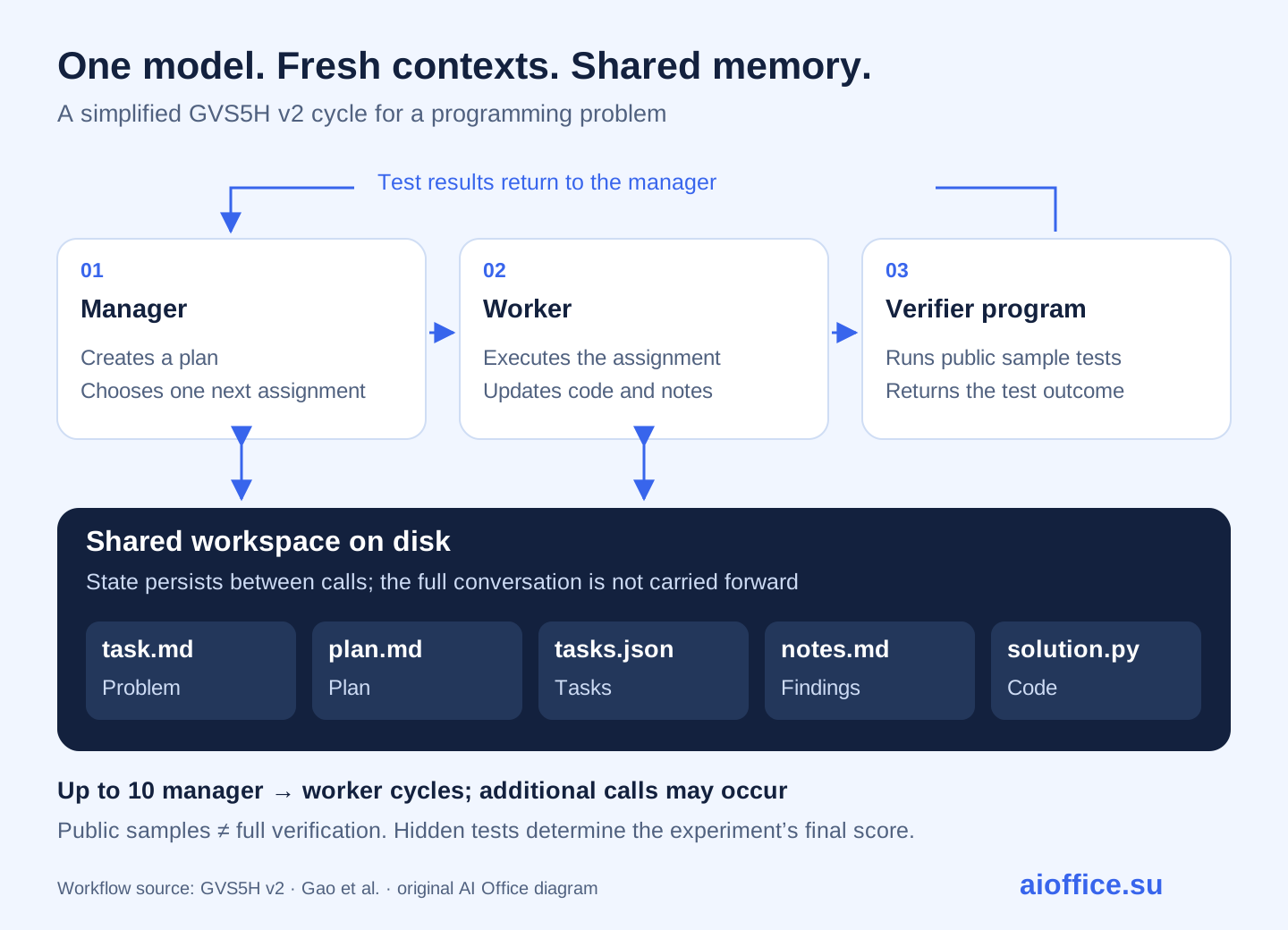
A programmatic verifier runs available public examples and returns the outcome to the manager. It is not another language model merely saying the code looks correct. In the study, this feedback was available for 73 stdin-format problems; 27 problems using a different format did not receive it. Hidden tests supplied the final evaluation. Gao et al. · GVS5H paper, pinned version ↗
The value of shared memory is easy to understand. Recounting the full history with every assignment can bury a useful rule or revive a rejected hypothesis. A concise work log passes the next worker a solution, its rationale and a concrete failure. An incorrect note can also propagate, so the log needs testable outcomes rather than confident prose alone.
Where “9% of the cost” comes from
That figure refers to Qwen3.8-Flash-Next with a manager. The authors price one pass over 100 problems at $5.76, compared with $61.11 for single-call Fable 5: approximately 9.4%. Their estimate for Qwen3.8-27B with a manager is $47.82, or about 78.3% of Fable 5’s cost. Attributing the nine-percent figure to the smaller 27B model would be incorrect. GVS5H · token-based cost estimates for 100-problem passes ↗
| Model | Single call | With manager | Relative to single-call Fable 5 |
|---|---|---|---|
| Claude Fable 5 | $61.11 | Not evaluated | 100% reference |
| Qwen3.8-27B | $18.95 | $47.82 | 78.3% with manager |
| Qwen3.8-Flash-Next | $2.73 | $5.76 | 9.4% with manager |
This is a calculation of consumed tokens multiplied by selected rates, not a measured cost of operating a local server. Qwen was served through the researchers’ own vLLM deployment, but public rates were applied for comparison. The table records the study’s assumptions, not a current commercial quotation; rates and discounts can change. GVS5H · token-based cost estimates for 100-problem passes ↗
A company should measure cost per accepted outcome: computation or API use, maintenance, waiting, human review and rework. A local station can reduce transfers to outside services and provide workload control. It does not automatically make each task cheaper. Sometimes a fast single response is more useful than an extended sequence of calls.
Scenario 1: reconciling exports and building a departmental tool
Imagine a purchasing department comparing supplier price lists with its own catalogue. Names vary, pack sizes differ and some item codes appear twice. The useful assistant would prepare a testable tool for processing the spreadsheets. This is a proposed application, not a published GVS5H customer case or an AI Office deployment.
The manager records matching rules and units. One pass identifies ambiguous fields, another writes a transformation, and the next investigates failures on a control sample. The log preserves accepted rules and unresolved exceptions. The deliverables should be code, a discrepancy report and rows requiring a human decision.
Tests use labelled examples: an exact item-code match, pack conversion, an empty price and a duplicate row. AI should not declare two products equivalent merely to complete a neat table. Measure time to an accepted report and the number of errors a person must correct. If exception handling takes longer than manual reconciliation, the workflow has not delivered value.
Scenario 2: preparing a 1C integration
A company wants confirmed orders transferred from an external system into a 1C test database. A shared work log could support field mapping, transformations, an integration draft and tests. This transfers the principle to another task: GVS5H did not evaluate BSL, MCP servers or real 1C databases.
The workspace holds the approved exchange schema, anonymised sample orders, test-interface responses and known failures. The manager assigns one step, such as handling a repeated order submission. A worker changes the relevant part, and a verification program sends test requests and compares the results.
A 1C specialist sets acceptance criteria: required fields, matching quantities and totals, correct duplicate handling and no unrelated changes. Creating or posting documents in the production database is a separately authorised action after verification. Orchestration helps organise development; access rights and accounting responsibility need their own design.
Scenario 3: changing an internal application
A service company might add overdue-ticket calculations to its dispatch system, accounting for its working calendar. Errors tend to occur at boundaries: weekends, missing values, status changes and time zones. A broad request to “add the calculation” can leave those conditions unspecified.
A work log can preserve approved rules, affected files and test outcomes. The manager scopes the next step, a worker proposes a change, and automated tests check expected dates and existing behaviour. A person receives a review package describing the change, rationale, tested cases and unresolved questions.
Evaluate this on the actual project. Success on algorithmic problems does not establish that an agent understands an unfamiliar architecture. A limited change with clear acceptance criteria and a rollback path makes a suitable pilot. Developer time to an accepted change, including correction of AI mistakes, is a useful metric.
Can it run on a local AI station?
The shared-log mechanism does not require a particular cloud provider. Qwen3.8-27B has publicly available weights; the GVS5H authors used local FP8 serving. This is not a test of our 96–128 GB station class. The model build, accelerator, context length and concurrent requests require separate validation. Qwen3.8-27B · official model-card snapshot ↗
For Flash Next, active parameters must not be confused with total model storage. Its official card lists 125B parameters with 6B active, plus separate n-gram embeddings and MTP. A small active fraction does not mean all weights require the memory of a 6B model. Flash Next’s results cannot automatically be transferred to any mini PC. Qwen3.8-Flash-Next · official parameter breakdown ↗
Sequential roles can reuse loaded weights. Long contexts, KV caches and lengthy responses still consume memory and time. Start by testing one suitable local model in a short work cycle. Cloud access can remain a controlled option, with explicit rules on which data may leave the company.
What must be added before operational use
The repository is a research implementation rather than a finished enterprise product. In the inspected sample-checking function, generated Python runs through subprocess with a timeout. That alone is not a sandbox. An operational implementation needs a separate execution user or container, network and file restrictions, resource limits and an execution environment without production secrets. GVS5H v2 · manager, workers, file ledger and sample verifier ↗
Licensing is also split: the project’s code is MIT, while the paper, illustrations and run results use CC BY 4.0. Problem statements and third-party components retain their own terms. The code can be studied and adapted under applicable conditions, but the entire directory should not be treated as a single MIT package. GVS5H · licensing by repository path ↗
All five models tested in both arms of the main series improved. Additional conditions showed different outcomes, including regressions for Qwen3.6-35B with reasoning disabled. An early mistaken plan can guide later calls down the wrong path. Agent count should therefore not become a project objective by itself. GVS5H · separate original-scaffold experiments, including regressions ↗
The evaluator changes also matter: the authors corrected handling of non-unique valid answers and program execution, then rescored the results. These are documented changes to their method; AI Office did not independently reproduce the benchmark. GVS5H · corrected per-problem verdict data ↗
How to test the idea in your company
Choose one repeatable process with a verifiable output. Assemble, for example, 20–30 anonymised tasks, define acceptance criteria in advance and compare a single call with a plan–act–verify loop using the same model. This sample size is a starting-pilot suggestion, not a scientific evaluation standard. Track money-related errors and data changes separately from minor comments.
Measure accepted outputs, staff review time, total elapsed time and cost. Preserve model versions, rules, inputs and final files. Add a budget stop and a manual fallback. A useful pilot demonstrates a specific process improvement that repeats on new examples.
GVS5H provides a reason to test work organisation alongside model size. AI Office can help examine a workflow, select a local model and design a limited pilot with explicit verification. Start with one team task: its input files, definition of completion and permitted actions.