Businesses looking for a capable AI assistant should consider more than hosted services alone. Qwen3.8-27B has openly available weights and can be deployed within a company's own infrastructure. Its point score in the checked Code Arena WebDev table exceeds several popular models offered through services. That is a reason to test local AI on your own workflow, rather than evidence that it is superior at everything.
What the checked leaderboard shows
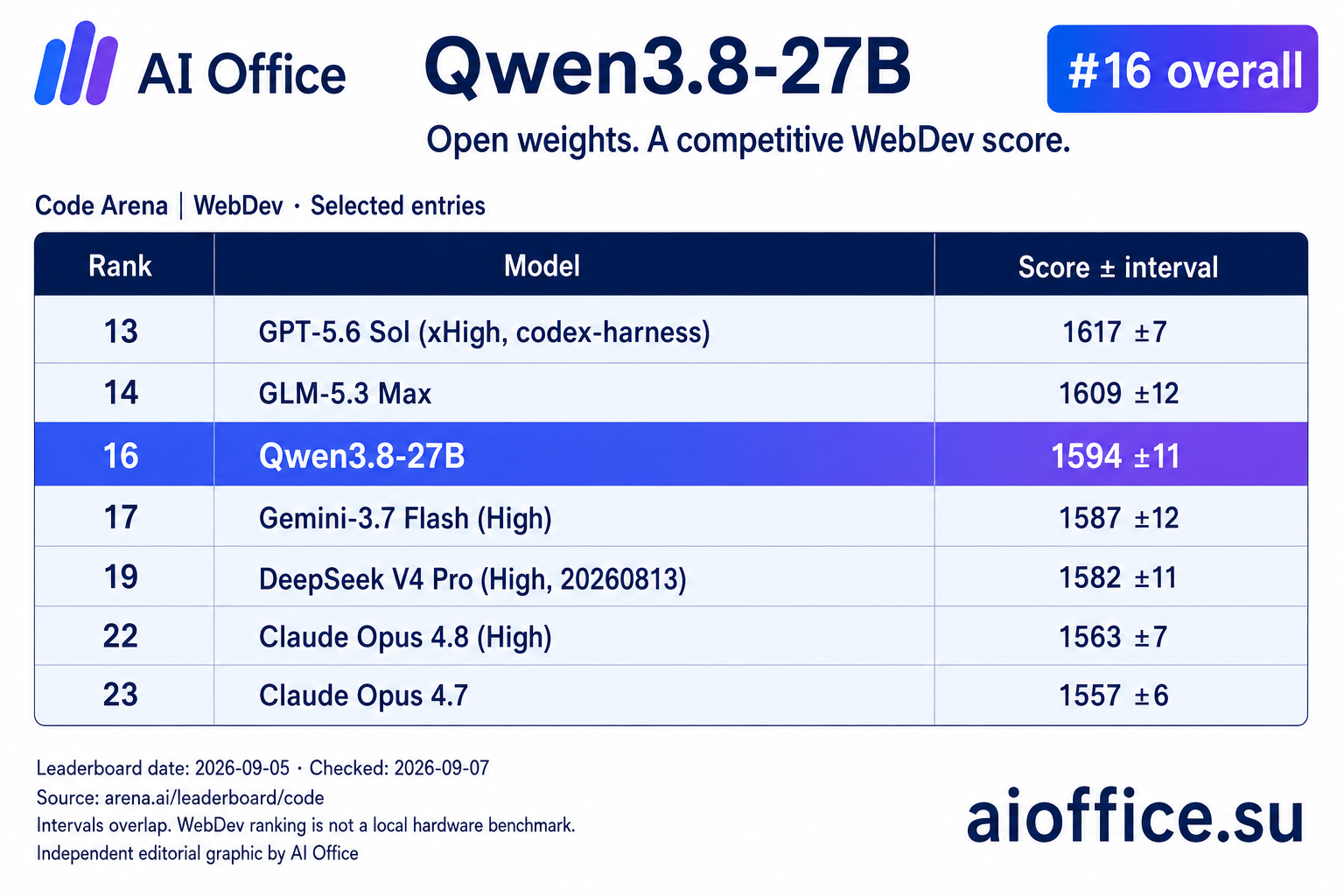
In Arena's table dated 5 September 2026, checked on 7 September, Qwen3.8-27B is ranked 16th with a score of 1594 and a reported interval of ±11. Our illustration selects neighbouring and lower-ranked entries; it is not the complete leaderboard. Positions change as models and votes arrive, so dates belong alongside the numbers. Arena · Code / WebDev ↗
Within this selection, Qwen is below the specified GPT-5.6 Sol entry and GLM-5.3 Max, but above Gemini-3.7 Flash High, DeepSeek V4 Pro High and the displayed Claude Opus versions. These are scores for particular leaderboard entries. They establish neither the parameter counts of proprietary models nor that a local mini PC is faster than a hosted service.
A higher score is not universal superiority
Arena uses response comparisons and human preferences: participants choose without initially knowing the model identities. The WebDev section concerns web development. That makes it informative for its task category, but not a substitute for evaluating contract review, arithmetic, confidentiality or integration reliability. Arena · How it works ↗
The intervals in the graphic matter. Nearby entries have overlapping intervals; a small difference between point estimates does not justify confidently declaring every pairwise winner. Reasoning settings, available tools and execution environments also belong to particular entries. We therefore preserve the relevant mode labels instead of reducing the comparison to vendor names.
Why this Qwen model is interesting
Qwen's official model card publishes weights, lists 27 billion parameters for the language component and identifies an Apache 2.0 licence. The developer describes text and visual capabilities and provides self-hosting examples. These support exploring local deployment. Qwen3.8-27B should not be confused with the separate Qwen3.8-Max model. Qwen · Qwen3.8-27B ↗
“Local” describes a deployment choice, not where the leaderboard evaluation took place. The Arena score is not a measurement on an AI Office station. Nor should the original configuration's result automatically be assigned to a compressed model: evaluate quality again after selecting weight format and runtime.
A business idea beyond a chat window
Consider a company approving purchases through email conversations. A local station could support a development-assistant pilot that turns a process description into a request form, an offer-comparison table and an approval-screen prototype. Begin with fictional data. A specialist reviews code, permissions, calculations and failure handling before connecting real systems.
This is where WebDev performance is directly relevant: the model helps construct interfaces. An attractive screen, however, is not yet a working process. A request needs states, ownership and history; changes to business records need approval and protection against repeated execution.
Another example is an internal equipment catalogue. The assistant can draft product cards and search screens from departmental requirements. Users gain something concrete to discuss, while a developer checks data mappings and prepares the service for operation. Evaluate time to an accepted prototype, including revisions, rather than time to the first generated screen.
Other local workflows to investigate
- Searching company documents with direct links to supporting passages. - Drafting sales proposals using an approved catalogue and price list. - Extracting fields from authorised documents with critical-value checks. - Explaining internal procedures and the employee's next step.
These are separate proposed workflows, not capabilities established by the ranking. Each needs its own examples and acceptance criteria. Building convincing web pages does not imply flawless invoice reconciliation. Use testable rules for arithmetic and explicit approval for external actions.
What about a 128 GB AI mini PC?
This hardware class is a reasonable candidate for technical evaluation, but memory capacity alone cannot justify a performance promise. Weights, request context, application state and overhead all consume memory. Runtime compatibility, model format, document length and active users matter as well.
A project can use a standalone memory-rich AI mini PC or an equivalent platform without committing to a particular vendor. Test the full job: document upload, retrieval, generation, opening evidence and recovering from a failed attempt. Check application network connections separately. Running your own model does not remove external integrations automatically.
Turn a ranking result into a useful pilot
Select one repeated task and prepare examples of acceptable outputs. Include difficult inputs and cases where requesting clarification is the correct outcome. Compare Qwen with the current way of working on identical assignments, counting review and correction time. Then decide whether quality supports a bounded deployment.
A strong open-model result expands a company's options. AI Office aims to turn that choice into useful document workflows, assignments and internal services on customer-controlled infrastructure. We can design a tailored arrangement and test it on a local station. The objective is a working process with clear boundaries; the leaderboard is a reason to try the model.