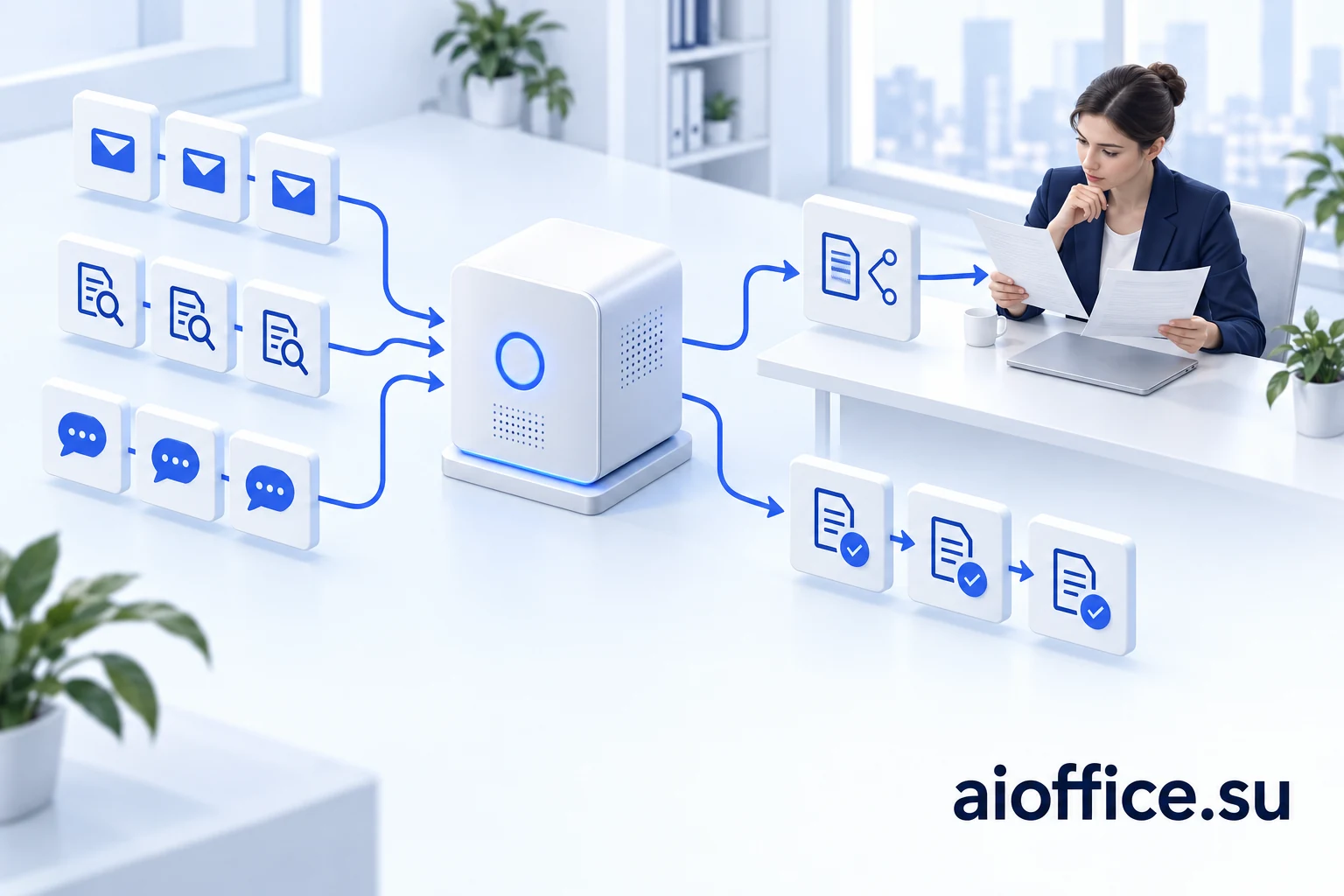
“We need a digital employee” can mean a document chat, automatic CRM updates or an assistant that chooses several steps to solve a task. Until that is clarified, comparing proposals, estimating cost and understanding automation boundaries is difficult.
For a business, a digital employee is useful as a defined role with incoming tasks, sources, tools, acceptance criteria and limits. The name helps discuss work. It does not turn a model into a person who knows every unwritten rule and independently bears responsibility.
Beyond ordinary chat
A chat can help phrase an answer or suggest an idea. A working role also needs to identify the task, retrieve current information, save the result and handle exceptions. Otherwise, an employee still transfers context and performs every action manually.
An AI office assistant might receive authorized email, classify it, extract details, find the related order and prepare a reply. Its output includes evidence and unresolved questions. The workflow then routes it for review or performs a preauthorized step.
Autonomy is not necessary everywhere. A narrow role that gathers confirmed statuses into one daily brief can be valuable. Reliably removing repetitive work does not require inventing new responsibilities.
Agents and predefined workflows
Anthropic's engineering discussion distinguishes predefined workflows from agents whose models dynamically choose steps and tools. It is a useful architectural distinction, although the industry uses “agent” in different ways. Anthropic · Building effective agents ↗
A known sequence—receive a file, extract fields, validate and save a draft—can be easier to control as a fixed workflow. Dynamic action selection is more useful when the necessary documents or number of clarifications are unknown in advance.
Autonomy has costs: more possible behavior, harder evaluation and potentially unnecessary calls or repeated actions. Choose the least independence sufficient for the task. Freedom sounds attractive in marketing; predictable outcomes matter more in operation.
Start with a role specification
Replace “help sales” with a short specification of triggers, sources, permitted actions and completion criteria. It helps management, implementation specialists and the person accepting the work.
- Input: the message, event or request that starts work.
- Output: what must be prepared or changed.
- Data: authorized systems, documents and versions.
- Authority: reading, drafting, writing or external action.
- Exceptions: when to stop and whom to contact.
- Acceptance: how quality is checked and confirmation retained.
Assign an owner responsible for rules, errors and changes. Without one, a technically healthy digital employee can gradually operate under obsolete instructions.
Good first tasks
Good candidates recur, have available inputs and produce verifiable results. Examples include classifying inquiries, extracting fields, finding current procedures, drafting meeting summaries and matching document rows to a catalog.
Evaluate operations rather than job titles. “AI accountant” is too broad for a starting commitment. “List differences between an order and invoice with references to the rows” has clearer boundaries. Decisions about accounting actions remain within the agreed process.
Not every suitable task needs an LLM. Ordinary software can check totals, required fields and exact identifiers. Models help with variable text and context; arithmetic and formal constraints should be checked separately.
Where a person is needed
Human involvement is especially valuable with ambiguous inputs, changed commitments and consequential decisions. A system can compare suppliers, while the choice may depend on terms missing from the table. It can draft a customer response without having authority to promise a new deadline.
Separate knowledge from permission. Correctly interpreting a situation does not authorize a price change, payment, access grant or personnel decision. The company defines permitted actions, not the model's persuasive tone.
OWASP describes excessive agency as a risk involving excessive functionality, permissions or autonomy. For a digital role, the practical implication is to provide necessary tools only and restrict consequential actions, including meaningful human approval where required by the process. OWASP · LLM06:2025 Excessive Agency ↗
Approval needs detail. A button without recipient, amount, terms and evidence does not support review. Approval should bind to a specific version rather than any future variation of the result.
Example: handling incoming inquiries
Consider an illustrative service company. A new email needs a customer match, classification, relevant instructions and a draft response. This is a design example, not AI Office implementation statistics.
The digital employee checks available history. Ambiguous customer identity should not cause it to insert information from the nearest match. Obsolete instructions or conflicts with a contract require escalation.
For a routine question, the system prepares an evidence-based response and next action. For a complaint, it prepares a case brief: the customer's statement, available records, missing information and the person responsible for review. Compensation or acceptance of obligations requires established authority.
Finally, retain the original message link and actual status. Draft prepared, sending authorized and handed to the mail service are different events. They should not all become a single “done” label.
Memory should support the task
A digital employee may need task context, approved rules and decision history. It need not retain every sentence forever. Separate current task state, corporate knowledge and temporary intermediate material.
If a customer changes address, the old value should not reappear from chat memory. Define an authoritative source, update process and conflict rule. Revoked document access affects search, caches, excerpts and prepared responses as well as the original file.
Employees should understand what is retained and why, particularly for email, meeting recordings and cross-department documents. A shared model does not imply shared access to all company information.
Independent operation needs resource limits
An agent can become stuck searching, repeatedly rewriting or retrying an unavailable service. Define limits for attempts, execution time, tool budget and stopping conditions. When a limit is reached, expose a clear state and a route to a person.
Repeated events should not create duplicate records. Recognize processed messages or identify a new task version. Before retrying an external action after failure, check what already happened.
“Available around the clock” means work can run while infrastructure and sources are available. It does not promise unlimited capacity, zero maintenance or instant responses to any queue. Test performance against the actual workload.
Accepting a digital employee's work
Evaluate tasks different from configuration examples. Include incomplete documents, unknown items, contradictions, unavailable sources and document text pretending to be instructions. The role must stop correctly as well as answer successfully.
Measure accepted results without major changes, review time, missed errors and unnecessary actions. One polished response does not establish behavior across diverse inquiries. Choose evaluation size according to variety and consequences rather than a decorative target number.
Measure economics per accepted result. Include setup, integrations, computation, support and review time. Faster drafting with more corrections may deliver little benefit. A successful pilot should demonstrate a change in the complete process.
Developing the AI Office digital workforce
The AI Office website describes possible roles in office administration, sales, support, procurement, contracts, marketing materials and meetings. These are directions for later expansion. Each requires agreed sources, permissions and quality criteria; a catalog title does not mean a ready-made deployment for any company.
Start with one role and route. After validation, add task types and selected authorized actions. Roles can share infrastructure and models while keeping data, instructions and permissions distinct.
A digital employee becomes useful when its work can be explained and accepted: what it received, what it did, what supports the result and where it stopped. We propose starting AI Office with that specification for one recurring team task, then testing it on real materials.