
“If we introduce AI, will we have to lay people off?” This question often comes before choosing a model or a server. The owner expects higher productivity; employees hear a discussion about headcount. A conversation about technology quickly becomes a conversation about people's future.
Adopting AI does not, by itself, determine team size. Automation changes the cost of individual tasks. Demand, quality, work organization and management decisions determine what follows. Radiology, a profession once predicted to disappear, offers a useful way to understand the distinction.
Hinton's forecast: a task was smaller than a profession
In a conversation published by Valence, Geoffrey Hinton recalls his 2016 prediction that radiologists would no longer be needed within five years. He acknowledges that his timing was wrong and clarifies that he meant reading scans. He still expects a future in which AI interprets images and a doctor checks the result. That is Hinton's expectation, not an established deadline for healthcare as a whole. Valence · AI Unpacked with Geoffrey Hinton ↗
The interesting point is not an opportunity to argue with a famous scientist. It is the gap between performing an operation and replacing an entire profession. Recognizing a finding in an image is only part of care: clinical context, discussions with colleagues, procedures, training and responsibility also matter.
The Royal College of Radiologists' 2025 census estimates a 32% shortfall in UK clinical radiology consultants. The same report stresses that their contribution extends well beyond interpreting scans. This describes a particular healthcare system, not a single global labor market. Royal College of Radiologists · Clinical Radiology Census 2025 ↗
A shortage does not prove that AI itself created additional jobs. Demand for imaging is also shaped by population aging, clinical pathways, access to diagnostics and funding. A profession can remain in demand while some of its operations are automated.
AI can automate tasks faster than professions disappear. But a profession surviving does not guarantee that every position survives.
Why cheaper work sometimes creates more work
In his 1865 book The Coal Question, William Stanley Jevons described the mechanism now called Jevons paradox. More efficient use of coal could increase total consumption: useful work became cheaper, making wider use of energy economically attractive. Saving a resource per operation does not necessarily save it across the whole system. W. S. Jevons · The Coal Question · Of the Economy of Fuel ↗
For labor, this is a useful analogy with conditions. If a service costs less to deliver, a company can lower prices, respond faster or reach customers who could not previously afford it. Additional orders may absorb the time released and create new demand for people. Neither lower prices nor new orders are automatic, however.
Consider an illustrative process: 100 orders require 100 hours of human work. Automation doubles productivity after accounting for review and corrections. At the original volume, only 50 hours are needed. With 200 orders, the process needs the original 100 hours. With 300, it requires 150 hours. These are assumptions to explain the mechanism, not a forecast of AI performance.
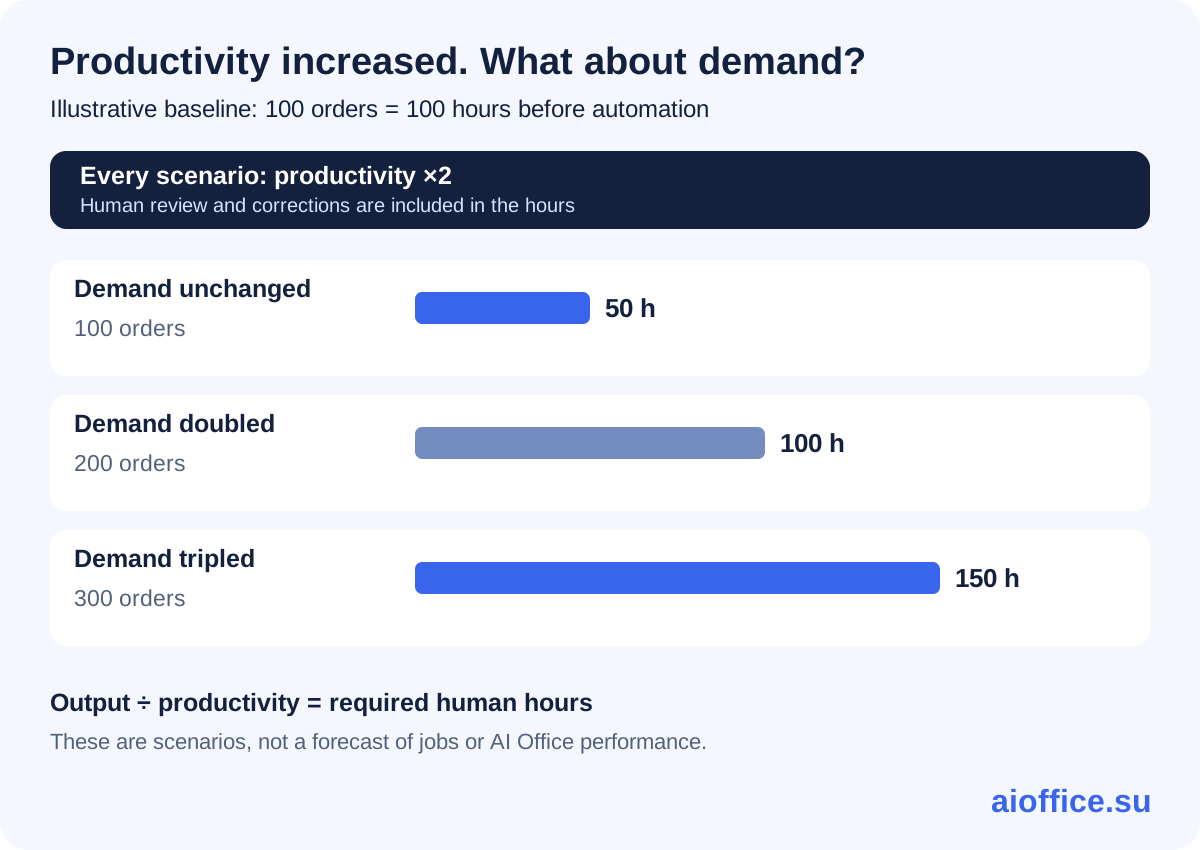
In this simplified model, required hours equal output divided by productivity. For hours to increase when productivity doubles, output must more than double. Headcount does not follow directly: schedules, different skills, peak workloads and other responsibilities still matter.
The claim that “AI will create more work because of Jevons paradox” therefore skips a critical condition: the market must want and pay for the additional output. Cheaper report preparation does not make customers buy a hundred unnecessary reports. More inquiries do not automatically become more profitable sales.
Demand is constrained by more than price
For a small company, the question is specific: is useful work being postponed because people lack time? Unanswered inquiries, slow proposals and irregular customer follow-up are possible opportunities. If automation removes that actual constraint, the existing team may be able to handle more business.
But the constraint may lie elsewhere: weak demand, limited equipment, a customer's lengthy approval process or a missing budget. A faster proposal draft then does little for sales. If the next stage can still handle only ten orders a day, a hundred prepared proposals create a queue.
Internal reporting also has a limit to its usefulness. A business may need twelve good monthly reports each year. Producing 120 to demonstrate activity does not create value. Management must deliberately use the released time for other work, reduce overtime or reconsider staffing requirements.
It is also important to distinguish a company from a market. A firm can reduce its team while an industry expands output and consumers gain access to a more affordable service. These outcomes can coexist. None promises that an individual employee will quickly find an equivalent job.
iKang: a real example of needing fewer people
A case published by the University of Hong Kong's CAMO center on June 3, 2026 describes iKang. The authors report that AI first reads and the transfer of much review work to 16 regional centers reduced the number of radiologists from 400 to 160, while annual volume remained around eight million images. A human still reviewed the entire scan and made the final judgment. HKU CAMO · iKang Nano Case · 3 June 2026 ↗
This is an account of one organizational change, not a controlled study of the whole market. It does not isolate a model's independent effect or justify applying the result to every clinic. Nor does the headcount change establish that exactly 240 people were laid off: staffing totals and the mechanisms by which people leave are different facts.
For a manager, the case prevents an overly comfortable claim that “AI only assists.” Assistance can change effort and task allocation enough for a company to need fewer people, particularly when service volume stays constant and work can be centralized.
What productivity and employment research shows
An April 24, 2026 Goldman Sachs Research analysis distinguishes labor substitution from augmentation. Its analysts associate the first with employment losses and the second with growth in some roles. These are estimates based on US data and selected AI exposure indexes, not an experiment establishing the future of every profession or the cause of every job cut. Goldman Sachs Research · AI substitution and augmentation · 24 April 2026 ↗
A May 6, 2026 ILO research brief summarizes substantial task-level productivity gains, typically 10–70%. Effects are often stronger for less experienced workers and well-defined text tasks. Firm-level findings are mixed, however: turning those gains into business-wide improvements requires changes to processes and skills. ILO · The Aggregation Paradox of AI · 6 May 2026 ↗
In practice, a successful demonstration is insufficient. A model may draft an email faster than a person, but the email can still wait for review, contain a pricing error or require manual transfer into a CRM. Generation time is only one part of the journey to an accepted result.
Suppose preparing a document previously took 60 minutes and a draft now appears in five. If review takes 25 minutes and corrections and data transfer take another ten, the process takes 40 minutes. The saving is 20 minutes, not 55. This is an illustrative calculation, not an AI Office measurement. Failed attempts and the reviewer's time must also be counted.
Junior and senior roles: examine the work itself
“AI will replace juniors but leave experts alone” is too crude a rule. A beginner may find information and prepare acceptable drafts faster with assistance. An experienced specialist can also be exposed if almost all their paid work consists of standardized execution that becomes easy to automate.
It is more useful to break a role into operations. For each, ask how repetitive it is, whether accurate inputs are available, whether the output can be checked, how costly an error would be and who is responsible for the consequences. The same employee usually performs tasks with very different answers.
| Process | Potential AI contribution | Human decision and review |
|---|---|---|
| Sales | Retrieve terms and prepare a proposal draft | Confirm prices, commitments and negotiation choices |
| Documents | Extract fields, compare versions and flag differences | Check material terms and decide what to accept |
| Customer support | Find instructions and prepare a response | Resolve exceptions and authorize compensation |
| Project management | Collect updates and flag overdue tasks | Change priorities, resources and commitments |
These are possible task allocations for a pilot. They do not mean every model can already perform the operations reliably. Even searching corporate knowledge requires current documents and source checks. Human sign-off is ineffective when the reviewer lacks the time or expertise to understand the result.
There is also the question of developing future experts. Removing all learning tasks from junior roles and leaving only acceptance of ready-made answers can undermine the route to independent work. Automation should therefore be accompanied by error analysis, explanations, practice without assistance and mentoring. Expertise does not appear simply because a job is called “AI reviewer.”
Introducing AI for employees: a pilot with a clear outcome
Start with a recurring process that has an owner. For example, preparing a response to an inquiry: find customer information, retrieve the contract, check terms, draft a response and pass it to the responsible person. Test the whole chain, including exceptions, permissions and manual rework.
Before starting, record baseline time, errors, queues and acceptance criteria. Include difficult and inconvenient cases. Comparing a normal working day with a few carefully chosen examples produces a polished demonstration rather than a basis for management decisions.
- Measure every participant's time through to an accepted result, including review and corrections.
- Track quality, complaints and returned work, alongside output volume.
- Include models, integrations, support and staff training in the cost.
- Decide in advance which useful work will receive the released time.
- Discuss new responsibilities, training and the project's real limits with employees.
Suppose a pilot releases ten hours each week. Value might come from clearing a backlog without overtime, responding faster or avoiding an additional hire as orders grow. With salaries unchanged, those hours are not yet a direct cash saving. The project must be assessed through what actually happens to the time.
If the objective really is to reduce staffing costs, it should not be disguised as a promise that nobody will be replaced. Clear discussion of consequences and transitions helps people participate in change. Without their knowledge of exceptions and unwritten rules, a process can easily be automated incorrectly.
Why AI Office starts with the team's process
We propose designing AI Office around specific company work: finding information in documents, preparing materials, tracking assignments and performing routine operations. AI handles agreed steps; employees receive prepared context and retain the decisions assigned to them by the process. Features, quality and automation boundaries are validated in a pilot.
A local AI station supports building that process within company infrastructure, with external models connected under agreed rules. This is a matter of data control and architecture. Local deployment alone does not guarantee productivity gains or the preservation of jobs.
A useful starting point for a manager is to identify tasks that consume the existing team's time and define what automation would make possible. Sometimes that means more customers. Sometimes it means fewer errors and less overtime. Sometimes testing shows that implementation is not yet justified.
“Will AI replace employees?” is too broad a question for deciding on a particular project. Ask what will change in people's work, who will verify results and where the released time will go. That is where we propose starting with AI Office: select one company process, test it on real materials and then decide how to expand automation.