“Why buy a local AI station when a cloud API costs only a few dollars per million tokens?” It is a reasonable question, but it compares different things: the price of a computer and a tariff for part of the work. Choosing between local AI and the cloud requires costing the whole process, from the initial request to a result the company can accept.
A million tokens is a useful billing unit. A business owner needs to know what it costs to process an enquiry correctly, check a document package or prepare a commercial proposal. We examine that economics using transparent examples, current tariffs and a 12–24 month horizon. All calculations below are scenarios, not measured customer deployment results.
The right unit is a successfully completed task
An agent receives an email, retrieves a contract, checks the CRM and price list, then drafts a reply. To the business, this is one task. To the model, it is several calls, each with its own input context, output and possible tool use.
Measure the cost of a successfully completed business task, not just the price of a token.
For a period, cost per accepted result equals all process costs divided by the number of results that pass evaluation. Failed attempts, retries and manual corrections remain in the numerator. If 100 runs cost $16 and 80 results are accepted, the API component alone costs $0.20 per successful task, rather than $0.16.
Define success in advance: correct details, current prices, required source references and acceptable turnaround. If one model passes automatic checks while another needs an employee to correct every result, comparing API bills alone hides a substantial difference.
Why the same request can consume different budgets
Models tokenize text differently. Output length, internal reasoning and the number of steps vary too. The same email does not guarantee the same usage across models, and a short visible answer does not establish a small bill.
For each call, token cost is uncached input multiplied by its rate, plus cached input multiplied by its rate, plus billable output multiplied by its rate. Rates quoted per million require dividing each token count by 1,000,000. Sum the costs of every call in the workflow.
OpenAI bills reasoning tokens as output tokens. When the API’s output count already includes reasoning, adding it again would double-count the expense. A retry is another call with its own usage, rather than a separate arbitrary surcharge. OpenAI · Reasoning models ↗
Tool services can add charges. OpenAI web search, for example, costs $10 per 1,000 calls, with search content charged according to the applicable token rules. One call in each of 6,600 workflows adds $66 per month before the content cost. An ordinary call to your own CRM does not necessarily incur a separate model-provider tool fee; that depends on the service and integration. OpenAI · API pricing ↗
Agent chains: how the budget accumulates
Results from earlier steps often become input to the next request. Imagine four steps with 10,000, 18,000, 27,000 and 39,000 input tokens. Total input processed is 94,000 tokens, even though the final context contains 39,000. This is an arithmetic illustration, not a measurement of a typical business workflow.
Rereading a document after an error or passing history to another agent increases usage. Growth need not be exponential: it depends on step count, new information and context management. Caching, selective document extracts, history compaction and stopping unproductive retries can change the economics.
A 2026 study by Bai and colleagues examined eight models using OpenHands on SWE-bench Verified. Each task was run four times, and complete history was carried into later steps. The authors report up to a 30-fold difference in token consumption between runs of the same task and show that additional tokens do not guarantee better accuracy. Bai et al. · How Do AI Agents Spend Your Money? ↗
This is coding research, not an evaluation of invoices or email processing. Its multipliers cannot simply be applied to a CRM workflow. The practical lesson is to measure complete agent runs repeatedly. One successful demonstration establishes neither typical cost nor expensive outliers.
What a hypothetical workflow costs at current rates
Assume a total budget of 30,000 uncached input tokens and 2,000 billable output tokens across every step of one run. Output already includes billable reasoning, if present. This is a fixed envelope for comparing tariffs, not a promise that different models achieve equivalent results or stay within that envelope.
Rates were checked on September 8, 2026. GPT-5.6 Sol uses the standard $4/$20 per million input/output tokens. Qwen3.8-Max uses the original $1.65/$4.951 rates for Global, Germany (Frankfurt), excluding temporary promotions; Singapore International lists different rates of $2/$6. DeepSeek V4 Flash uses peak rates of $0.44/$1.32 with an input cache miss. OpenAI · GPT-5.6 Sol ↗ Alibaba Cloud · Qwen3.8-Max pricing ↗ DeepSeek · Models & Pricing ↗
| Model | Input $/1M | Output $/1M | Run, $ | Month, $ | Year, $ |
|---|---|---|---|---|---|
| GPT-5.6 Sol | 4.00 | 20.00 | 0.16 | 1,056.00 | 12,672.00 |
| Qwen3.8-Max · Frankfurt | 1.65 | 4.951 | 0.059402 | 392.05 | 4,704.64 |
| DeepSeek V4 Flash · peak | 0.44 | 1.32 | 0.01584 | 104.54 | 1,254.53 |
The calculation excludes caching and Batch discounts, promotions, tools, taxes and payment fees. DeepSeek’s listed off-peak rates are half its peak rates; published peak windows are 01:00–04:00 and 06:00–10:00 UTC on weekdays. Actual cost depends on request timing. Region, account availability and payment arrangements must be checked for the company concerned.
This table does not rank model quality. Qwen3.8-Max here is a cloud API, not the same model as a smaller local Qwen. A cheap API may be the best option when it reliably meets acceptance criteria. Test that before justifying hardware by comparing it only with an expensive model.
What changes at 100, 300 and 1,000 tasks per day
Assume 22 working days per month. Every new task has the same illustrative token envelope; retries within it are already included. When a real agent retries beyond the envelope, add measured usage rather than an arbitrary contingency multiplier.
| Model | 100 tasks/day | 300 tasks/day | 1000 tasks/day |
|---|---|---|---|
| GPT-5.6 Sol | 352.00 | 1,056.00 | 3,520.00 |
| Qwen3.8-Max · Frankfurt | 130.68 | 392.05 | 1,306.84 |
| DeepSeek V4 Flash · peak | 34.85 | 104.54 | 348.48 |
In this model, 300 daily GPT-5.6 Sol runs cost $1,056 per month for tokens alone. DeepSeek V4 Flash at peak rates costs $104.54. That is nearly a tenfold difference before considering local hardware. “Local AI always wins at high volume” would therefore be too strong a conclusion.
Measure mean cost, accepted-result rate and expensive outliers, such as the 95th percentile, below which 95% of observations fall. Bound steps, retries and workflow spending. Otherwise, an occasional task stuck in a loop can noticeably change a day’s average.
A local server removes token billing, not operating costs
A locally operated model has no separate provider charge for each generated token. Hardware, implementation, electricity, support, licences, backups, update validation and people’s time still cost money. Once the computer is fully occupied, more work requires a queue or more capacity.
A hypothetical RUB 280,000 computer is not a complete AI Office deployment. The website lists an indicative hardware package of RUB 299,990–349,990, implementation of three workflows at RUB 500,000–800,000, and support separately at RUB 30,000–100,000 per month. These are preliminary estimates from the September 5, 2026 proposal; final scope and pricing depend on the project. Do not compare hardware alone with an entire cloud workflow, or API calls alone with a completed implementation.
Electricity should be estimated from measured load. A hypothetical 200 W average over 30 days of continuous operation consumes 144 kWh. At an assumed RUB 8/kWh, that is RUB 1,152 per month. Both power and tariff are assumptions, not station specifications or your region’s electricity rate. Include required storage, network equipment and redundancy.
Hybrid operation: local routine, cloud by policy
A model router can send routine tasks to a local model and complex exceptions to an external one, where data transfer is permitted. Candidates for a pilot include enquiry classification, RAG retrieval, field extraction, short replies and preparing CRM changes.
OCR, transcription, embeddings and reranking may also run locally, but require their own models and resources. They are not free capabilities of a single language model. Test the complete process, not only text generation speed.
Suppose the local path produces acceptable results for 90% of tasks and 10% use GPT-5.6 Sol. If those cloud tasks retain the same average token envelope, the token bill falls from $1,056 to $105.60. This is a scenario assumption, not a verified AI Office coverage rate.
Complex exceptions can cost more than average. If the remaining 10% consume three times the tokens, the cloud bill becomes $316.80. Include local attempts before escalation, router work and human review. Automatic transfer of confidential documents for a cheaper answer must not bypass company policy.
Comparing costs over 12 and 24 months
Define two illustrative budgets for the same functions. Cloud: RUB 500,000 upfront and RUB 30,000 per month excluding API usage. Hybrid: RUB 800,000 upfront, including hardware, and RUB 35,000 per month excluding API usage. These are scenario budgets, not a cloud product quotation or a new AI Office price offer.
The recurring budget is assumed to include support, infrastructure, electricity, backups, licences and result review. A real project must itemize these. In the example they remain constant, quality and deadlines are equivalent, one station has sufficient capacity, and 10% of tasks use the cloud at the original average envelope. Taxes, financing, equipment residual value and monetized risk are excluded.
Conversion uses the Bank of Russia’s official September 8, 2026 rate: RUB 86.1909 per US dollar. This is a fixed scenario rate, not a forecast or guaranteed payment rate. Volume is 300 tasks per day and 22 working days per month. Bank of Russia · USD/RUB · 08.09.2026 ↗
| Comparison API | Cloud 12 mo | Hybrid 12 mo | Cloud 24 mo | Hybrid 24 mo |
|---|---|---|---|---|
| GPT-5.6 Sol | 1,952.2 | 1,329.2 | 3,404.4 | 1,858.4 |
| Qwen3.8-Max · Frankfurt | 1,265.5 | 1,260.5 | 2,031.0 | 1,721.1 |
| DeepSeek V4 Flash · peak | 968.1 | 1,230.8 | 1,436.3 | 1,661.6 |
With GPT in this scenario, hybrid operation requires RUB 300,000 more upfront but saves about RUB 76,900 each month. Cumulative costs intersect after approximately 3.9 months. With Qwen, the intersection is about 11.8 months. Against inexpensive DeepSeek, hybrid operation does not recover the extra investment within either one or two years.
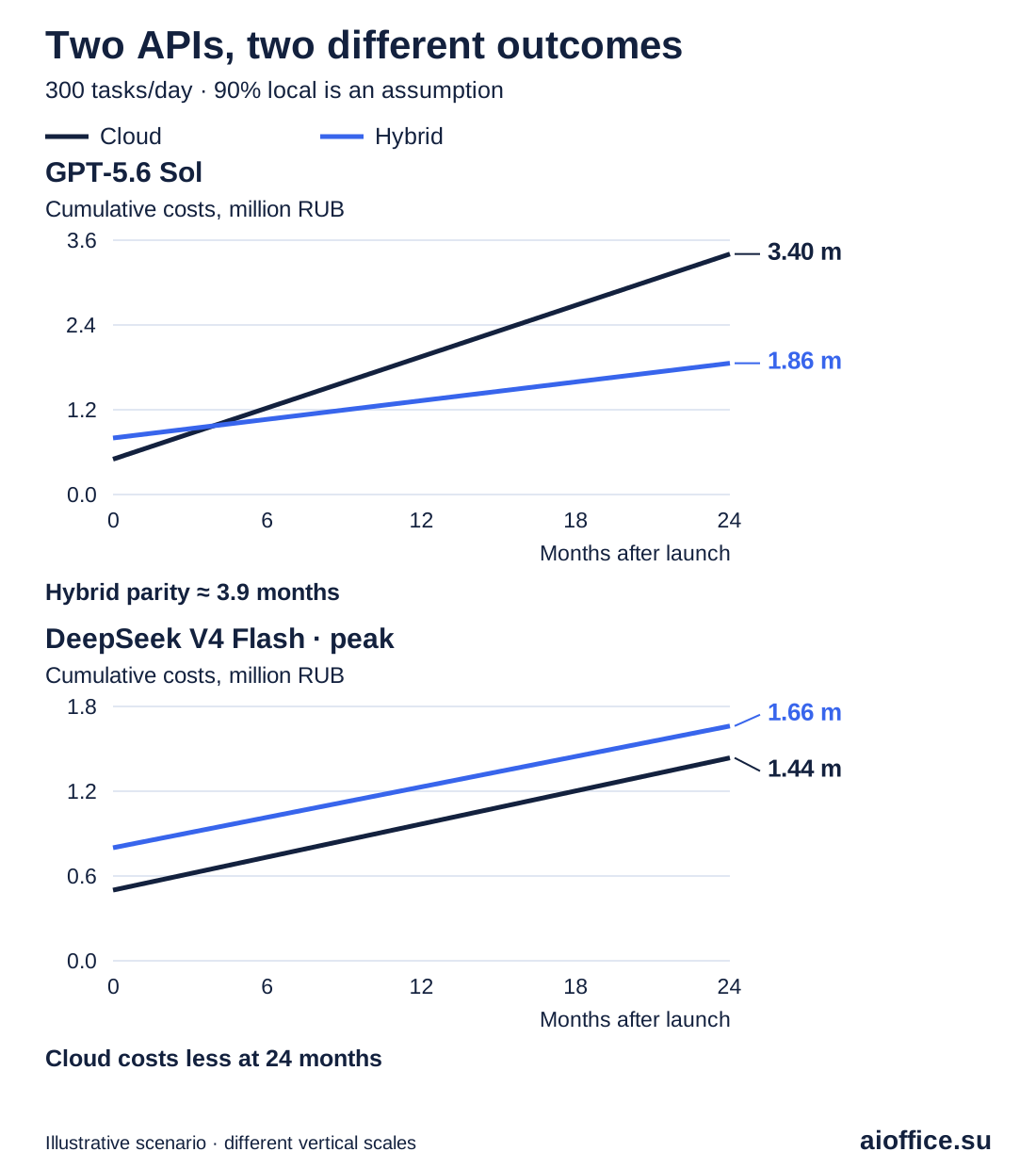
This is recovery of incremental investment relative to cloud operation, not proof that automation pays for itself. Assess the project separately against demonstrated business value: released capacity, faster processing or fewer errors. Do not treat every saved minute as a reduction in payroll expense.
When local AI does not pay back
Time to cost parity equals the additional investment in the local option divided by monthly savings after its additional operating expenses. If savings are zero or negative, there is no intersection under those assumptions. “90% less API spending” does not mean “90% less total AI spending”.
At 100 tasks per day with the GPT profile and other assumptions unchanged, parity moves to about 13.4 months. At 20 daily tasks, net savings are only about RUB 461 per month, so the extra investment is not recovered within 12–24 months. At a lower volume, savings can turn negative. Nor can 1,000 daily tasks automatically be declared a profitable local workload: capacity and deadlines must first be validated.
Cloud operation often suits infrequent or uneven demand, experiments and work that consistently requires a strong model. Local operation deserves evaluation for steady, repetitive work and data-control requirements. If external data transfer is prohibited, that is a selection constraint, not an invented monetary discount.
What an AI Office pilot should demonstrate
The AI Office Bench idea is best understood as evaluation on a particular company’s tasks. The name itself does not establish a shipped evaluation product or a local coverage percentage. An implementation decision needs a reproducible set of examples, acceptance criteria and actual usage logs.
- Compare models on identical documents and criteria: what constitutes a correct answer, and who accepts it?
- Measure whole chains, retries and failures; track input, cache, output, tools and human review time separately.
- Establish the share of tasks actually completed locally and the cost of complex cloud exceptions.
- Test realistic concurrency: RAG, OCR, models and CRM operations can compete for resources.
- Record cost per accepted result, turnaround time and rules for stopping expensive or unsafe actions.
Recalculate quarterly and when workload changes. New models may improve outcomes on existing hardware, but compatibility, licences, memory and speed require validation. Cloud prices can change in either direction too. Do not build a two-year business case around a promised model that has not been released.
Buy computation around the company’s work
Cloud AI resembles a taxi: occasional journeys do not require owning a car. Daily use changes the calculation, but fuel, maintenance and driver capabilities still matter. Enterprise AI follows a similar pattern: regular use matters, while the decision depends on the full costs and result quality.
AI Office is designed around local-first operation with controlled use of cloud models. Keep high-volume work local where quality and load tests support it; use external models when their results justify the expense and data transfer is permitted. Start with one process and its measurable cost, so architecture follows your company’s actual economics.