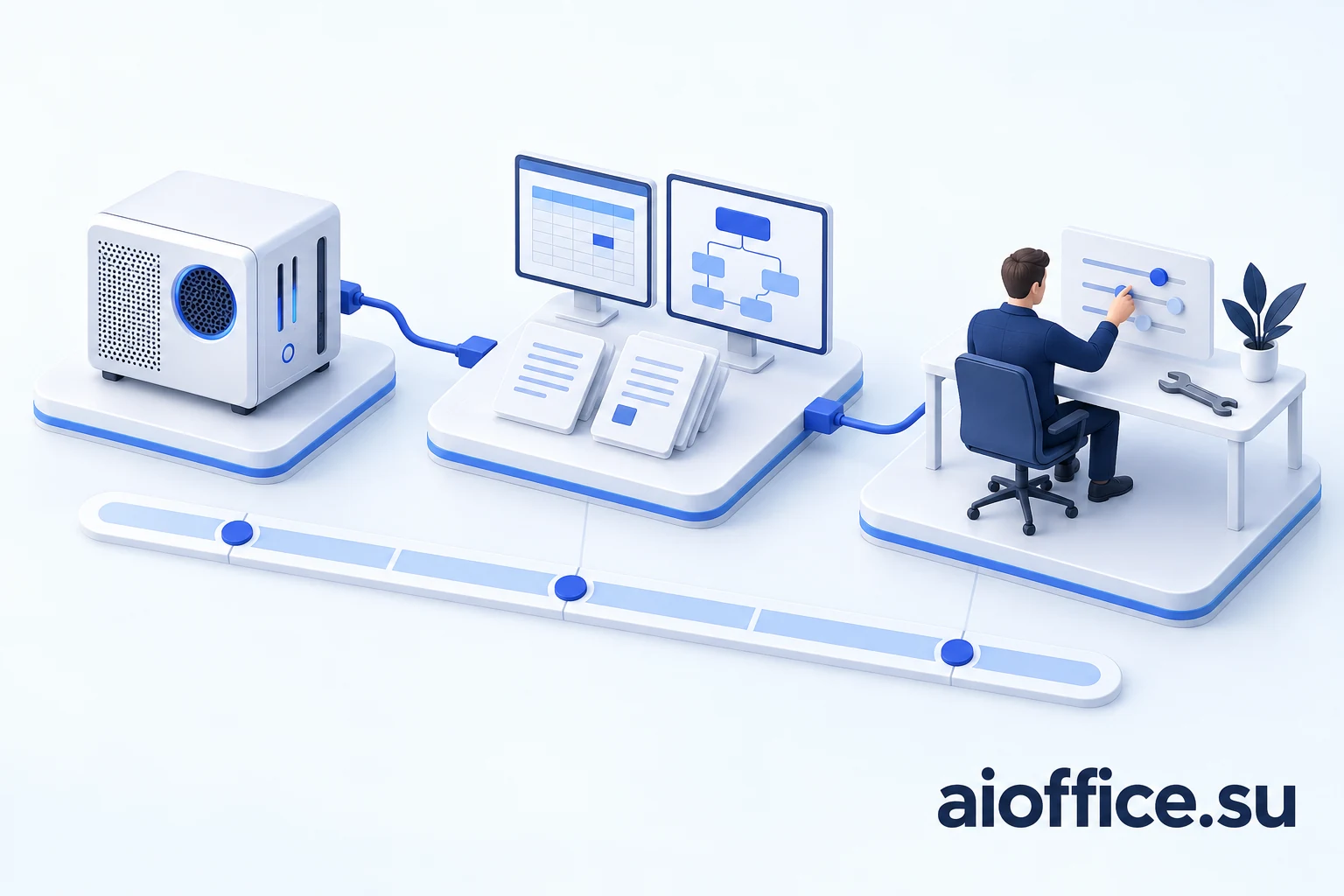
“How much does business AI cost?” becomes a difficult question when three different offers appear in the same conversation: a chat subscription, a server running a model, and a system that reads documents, connects to a CRM and routes decisions for approval. They deliver different outcomes, so their price tags alone are not comparable.
An implementation budget starts with a workflow: its input, output, reviewer and definition of completion. That route determines integrations, data preparation, hardware and support. Here is how to build a useful estimate, uncover omitted costs and test the economics before a large purchase.
Define the outcome before comparing prices
“AI for sales” is too broad for an estimate. “Use an incoming request to find current catalogue items, prepare a proposal draft and give the manager the pricing sources” is concrete enough to investigate. Request volume, attachments, reference data and review time become measurable.
Two projects using the same model can cost very different amounts. Searching a folder is one scope; checking stock, negotiated discounts and payment terms is another. Additional spending often buys reliable connections, exception handling and verification, rather than a more intelligent model.
Before requesting a quote, provide one or two ordinary examples and one awkward case: incomplete information, an old price list or a customer with several legal entities. This makes the scope easier to estimate and the deliverable easier to assess.
Separate startup and recurring costs
Startup costs create the working process. Recurring costs keep it useful after launch. An estimate should distinguish the following items:
- Discovery: sources, access, constraints, baseline measurements and acceptance criteria.
- Technical pilot: testing models, hardware and agreed workflows.
- Hardware: the station, storage and separately specified backup and power equipment.
- Integrations: accounting systems, CRM, mail and files, including exchange rules.
- Knowledge preparation: formats, freshness, duplicates, permissions and document structure.
- Application logic: templates, retrieval, routing, approvals and logs.
- Handover: staff training, documentation, configuration transfer and recovery testing.
- Operations: support, updates, quality checks, external APIs and infrastructure payments.
Include your own team's participation. A fixed supplier price does not eliminate the time needed to explain processes, arrange access and accept the work. Internal availability affects both delivery and economics.
Downloadable model weights do not make a complete system free
Being able to download weights does not remove licensing conditions, computing requirements or implementation work. Check the licence for the actual model artifact and intended use; a presentation describing something as open source is not a substitute.
Then consider the surrounding workflow. What extracts text from scans? Where is the search index built? How are changed contracts reflected in the knowledge base? What happens when memory runs out? Who tests whether a new model version confuses similar product codes?
A local deployment can reduce per-request model charges while creating operational costs. That is a trade between cost categories. Our separate local-AI-versus-cloud-API article covers computing economics; this article considers the complete working process.
Choose hardware for the workload
The cost of a usable local language-model deployment depends on tasks, simultaneous users, document length, acceptable waiting time and required quality. Fitting a model into memory does not establish that a department can use it comfortably at peak load.
An answer from an instruction manual and a batch of long scanned documents create different demands. Speech recognition, OCR and text generation can compete for resources. Test a realistic queue, not just one impressive response.
A technical pilot should record the configuration, model versions, load, response time and accepted-result rate. Select the hardware after these measurements. An expensive server cannot repair outdated source data or missing integrations.
Also agree how the system can grow: which work can wait in a queue, what needs another node and what may use an external service. Cloud access belongs in both the budget and the data policy.
Integrations can matter more than the model price
“Connect the accounting system” could mean reading one directory or writing transactions under business rules. “Connect email” could mean analysing one folder or handling many mailboxes, permissions, attachments and duplicates. These are different scopes.
The estimate should name exchange directions, record types, update frequency and failure handling. Clarify who maintains a customised accounting configuration and what happens after it changes.
An inexpensive prototype may read a manually prepared export. A production process needs to know whether that export is current, whether a record has already been processed and whether the user may see its contents. Make this difference explicit before launch.
With a limited budget, read-only access and draft preparation can be a sensible first stage. They allow usefulness to be tested before write permissions are introduced. Describe the deliverable accurately: a draft is not a completed accounting transaction.
What AI Office's published estimates cover
As checked on 8 September 2026, AI Office's website presents preliminary figures from a proposal dated 5 September 2026: a technical pilot at RUB 60,000–100,000, hardware at RUB 299,990–349,990, and implementation of three workflows at RUB 500,000–800,000. Hardware plus implementation totals RUB 799,990–1,149,990. Support is separate at RUB 30,000–100,000 per month. AI Office · Preliminary project budget ↗
The pilot is credited towards implementation if the project continues; hardware is charged separately. Do not automatically add the full pilot price to the full implementation price. Record the credit arrangement in the project documents.
These are preliminary estimates for a specific proposal, not market averages or a binding public offer. Delivery, taxes/VAT, warranties and licences require a final quote. A second node, external storage, paid APIs and additional modules are excluded from the stated total. Hardware compatibility and exact delivery scope require validation and an approved specification.
Calculate at least the first operating year
Total cost of ownership over a chosen period includes startup spending, recurring payments, internal participation and agreed additional expenses. Use the same time horizon and workload when comparing offers.
Consider a hypothetical example, not an AI Office quote. Startup costs RUB 900,000, support costs RUB 45,000 per month and other recurring expenses add RUB 10,000 monthly. The first year is therefore 900,000 + 12 × 55,000 = RUB 1,560,000, before anything omitted from those assumptions. Startup work does not automatically recur in year two, although expansion or replacement costs may arise.
Compare a cloud proposal on the same basis: integrations, subscriptions, document processing, model requests, storage, support and staff involvement. Comparing a server price with a monthly subscription conceals substantial costs on both sides.
Support terms also matter. Business-hours advice and a commitment to restore a critical workflow within an agreed interval are different services. Ask for service hours, contact channels, update scope and responsibility boundaries.
Released working time is not automatically cash savings
Measure the existing process first: incoming and completed tasks, search time, preparation, review and corrections. After the pilot, measure the same things, including manual work around AI.
Suppose the business handles 1,000 comparable tasks a month and saves 12 minutes per task including review. That releases 200 hours. At an internal planning value of RUB 1,000 per hour, the time equivalent is RUB 200,000.
It does not follow that RUB 200,000 has been saved in cash. If salaries and staffing stay the same, cash expenditure may be unchanged. The team might fulfil more orders, reduce overtime or postpone recruitment. Validate each effect separately and avoid counting the same capacity twice.
Only if the business actually realises RUB 150,000 in monthly cash benefit before new operating costs, and operations cost RUB 55,000, does the net monthly benefit become RUB 95,000. A simple payback estimate for RUB 900,000 of startup spending is then about 9.5 months after reaching that operating level. This excludes ramp-up, seasonality, the cost of capital and workload changes. It demonstrates arithmetic, not a return promise.
A pilot needs permission to fail
A useful pilot reduces uncertainty. It may reveal costly integrations, insufficient documents or review effort that consumes the entire benefit. Discovering this before a full purchase has value.
Agree the example set, minimum acceptable quality, waiting time, data constraints and stopping rule in advance. Include errors and incomplete requests. Managing AI risk throughout its lifecycle is consistent with the voluntary NIST AI RMF approach; specific acceptance thresholds belong to the project, rather than being supplied by NIST. NIST · AI Risk Management Framework ↗
If the pilot succeeds, its measurements inform the estimate and expansion plan. If it does not, change the workflow or stop. Money already spent on a demonstration is not evidence for further investment.
Request an estimate you can actually compare
Provide a short process description, sample input and expected output, monthly volume, existing systems and data restrictions. Ask suppliers to separate hardware, implementation, recurring payments, exclusions and acceptance criteria.
The useful question is how much it costs to bring this particular task to an accepted result. AI Office starts that discussion with a limited workflow scope and a technical pilot, connecting the budget to actual work rather than an abstract amount of model power.