
The aircraft takes off, the connection disappears and negotiations begin in a few hours. An executive needs to recall contract terms, compare two proposals and examine the team’s arguments. The documents are downloaded, but the familiar cloud assistant no longer responds.
Laptops powered by NVIDIA RTX Spark N1X make another arrangement interesting: the model, relevant documents and decision-preparation tools travel with their user. For AI Office, this is a possible development direction—a portable workspace with a bounded set of company knowledge. Here is what the platform offers and how a useful offline workflow could be designed. Information was checked on November 1, 2026.
RTX Spark N1X is a platform for different laptops
RTX Spark N1X is not the name of one laptop. NVIDIA announced availability of PCs using the platform on October 16, 2026, naming ASUS, Dell, HP, Lenovo, Microsoft and MSI. Actual configurations and availability depend on the manufacturer and market. NVIDIA: RTX Spark PC availability announcement, October 16, 2026 ↗
NVIDIA’s laptop specification lists two variants: a 20-core Grace CPU with a 6,144-core Blackwell RTX GPU and up to 128 GB of unified memory, or an 18-core CPU with a 5,120-core GPU and up to 64 GB. Windows 11 is supported. The 45–80 W TDP range concerns the chip, not total laptop consumption. NVIDIA: RTX Spark laptop configurations and specifications ↗
Microsoft Surface Laptop Ultra is one example. An executive’s choice need not be limited to it: screen, weight, cooling, support and configuration matter. Properties of one chassis should not be attributed to every N1X laptop. Microsoft: Surface Laptop Ultra, unified-memory and battery-test limitations ↗
Shared CPU/GPU memory is the key feature for local AI. However, 128 GB is not 128 GB of unused dedicated VRAM. Microsoft states that GPU-addressable memory is smaller than the total and depends on configuration and workload. Windows, applications, indexes and working data also need room. Microsoft: Surface Laptop Ultra, unified-memory and battery-test limitations ↗
What kind of offline access does the executive need?
No internet and no connection to the office are different conditions. On the company’s local network, AI Office can reach locally hosted services without an external cloud. On a trip, the same browser tab cannot reach the office server on its own.
Full independence requires the necessary application, model, search and permitted data to run on the laptop. Alternatively, a separate mobile workspace could use a prepared document package and a reduced feature set. Both require integration beyond downloading model weights.
| Mode | Available work | Main constraint |
|---|---|---|
| Office LAN without internet | Local station services and data | Connection to that LAN and available servers |
| Full installation on N1X | Local components and prepared data | Validated port of the complete environment |
| Mobile travel package | Permitted copies, search and drafts | Package design, version control and result return |
In this article, mobile offline AI Office is a proposed development and pilot scenario. The current prototype has no finished mechanism for transferring a corporate knowledge base to N1X with bidirectional synchronization.
A useful rule is to show which data version underlies each answer. A Friday-evening snapshot can support Monday negotiation preparation, but cannot confirm current inventory or a payment received that morning.
Local models to consider
A first pilot does not need the largest model. Official Qwen3.5-4B and Qwen3.5-9B cards describe compact models with a vision component. Qwen3.8-27B is a larger candidate for complex requests. Available weights do not establish a working installation on a particular laptop. Qwen3.5-4B: official model card ↗ Qwen3.5-9B: official model card ↗ Qwen3.8-27B: official model card ↗
| Model | Proposed task | What to validate |
|---|---|---|
| Qwen3.5-4B | Short summaries, note structure and simple drafts | Preserving conditions and avoiding invented facts |
| Qwen3.5-9B | Answers from retrieved documents and meeting preparation | Citations, contradictions and Russian-language work |
| Qwen3.8-27B | Complex memos, comparing options and analytical roles | Quality, latency, context and memory consumption |
| Qwen3-Embedding-0.6B | Semantic search within an approved package | Index compatibility, reindexing and retrieval coverage |
The proposed roles in this table are evaluation ideas, not N1X test results. Check Russian-language performance, citation accuracy, omitted conditions, recognition of missing data and speed on your own documents. A larger model does not guarantee a better answer for every task.
Qwen3-Embedding-0.6B serves a different role: finding relevant excerpts rather than writing the management answer. Local RAG requires search, its index and the conversational model to remain available without an external API. This embedding candidate also needs AI Office integration and validation. Qwen: Qwen3-Embedding-0.6B official model card ↗
It helps to understand scale. Storing each of 27 billion parameters in exactly four bits gives 13.5 GB in decimal units. This is a theoretical lower estimate for those parameters alone, not a finished file or total system requirement. Quantization format, the vision component, metadata and context state add memory.
Context consumes resources separately. A documentation reference to a million-token mode does not establish comfortable laptop operation at that length. An executive will often benefit more from a few relevant excerpts with evidence than from placing the entire company library in one request.
Scenario one: preparing for negotiations while travelling
Consider a fictional example. A director is visiting a supplier. The approved package contains a contract, two proposal versions, previously agreed conditions and a note describing the meeting’s purpose. The assistant should map differences in price, delivery, advance payment, warranty and unresolved questions.
A useful result combines a statement, a reference to a specific source and its version. If a deadline appears only in the older proposal, that should be visible. Conflicting conditions should not silently resolve to the more convenient value.
The executive can request a draft agenda, questions and several response options. These can be prepared without connectivity if both materials and processing are local. Sending a message or accepting obligations remains a separate step after review and reconnection.
The value is continued substantive preparation during travel. A particular number of hours saved cannot be promised beforehand; it must be measured together with review and correction time.
Scenario two: comparing offers and checking figures
A sales director needs to compare several suppliers. A model can explain differences and identify missing information. Prices, discounts, tax and totals should be calculated in code under agreed rules, retaining links to source rows.
AI Office already follows this principle in its prototype: Excel/CSV catalogs, reviewed line items, ruble quotation calculations, versions and DOCX/PDF export. The model does not set prices or make payments. Moving that workflow into an independent laptop environment requires separate compatibility and data work.
An offline price list needs an effective date. A changed server price cannot reach the laptop without an update. A quotation prepared during travel may therefore remain a draft until reconnection allows checks against the current catalog and permissions.
This approach also helps answer “why did the total change?” and “which inputs are missing?” The assistant explains the calculation and assumptions. It should not invent current revenue, account balances or a financial model from a few old files.
Scenario three: examining a decision with an analyst council
An executive considers bidding for a tender, switching suppliers or launching a workstream. It can help to ask questions from strategy, finance, operations, contractual and critical perspectives in sequence. These lenses can reveal overlooked assumptions.
The AI Office prototype includes an analyst council: several roles of one configured model use accessible source excerpts, followed by a synthesis. These are perspectives, not independent experts. Agreement among outputs of one model does not replace verification.
On a laptop, this workflow should be evaluated sequentially with bounded context. Multiple roles mean more model calls and waiting. We have not measured council quality or execution time on RTX Spark N1X.
An offline result could be a memo covering options, evidence, risks, unknowns and questions for the team. A person chooses the assignee, deadline and action. Access to office tasks and applying changes after travel need their own approved route.
A possible portable AI Office design
Before departure, the executive selects a project and purpose. The system assembles a permitted package: documents, versions, required data and preparation time. Local search should preserve source references, and outputs should distinguish drafts from accepted decisions.
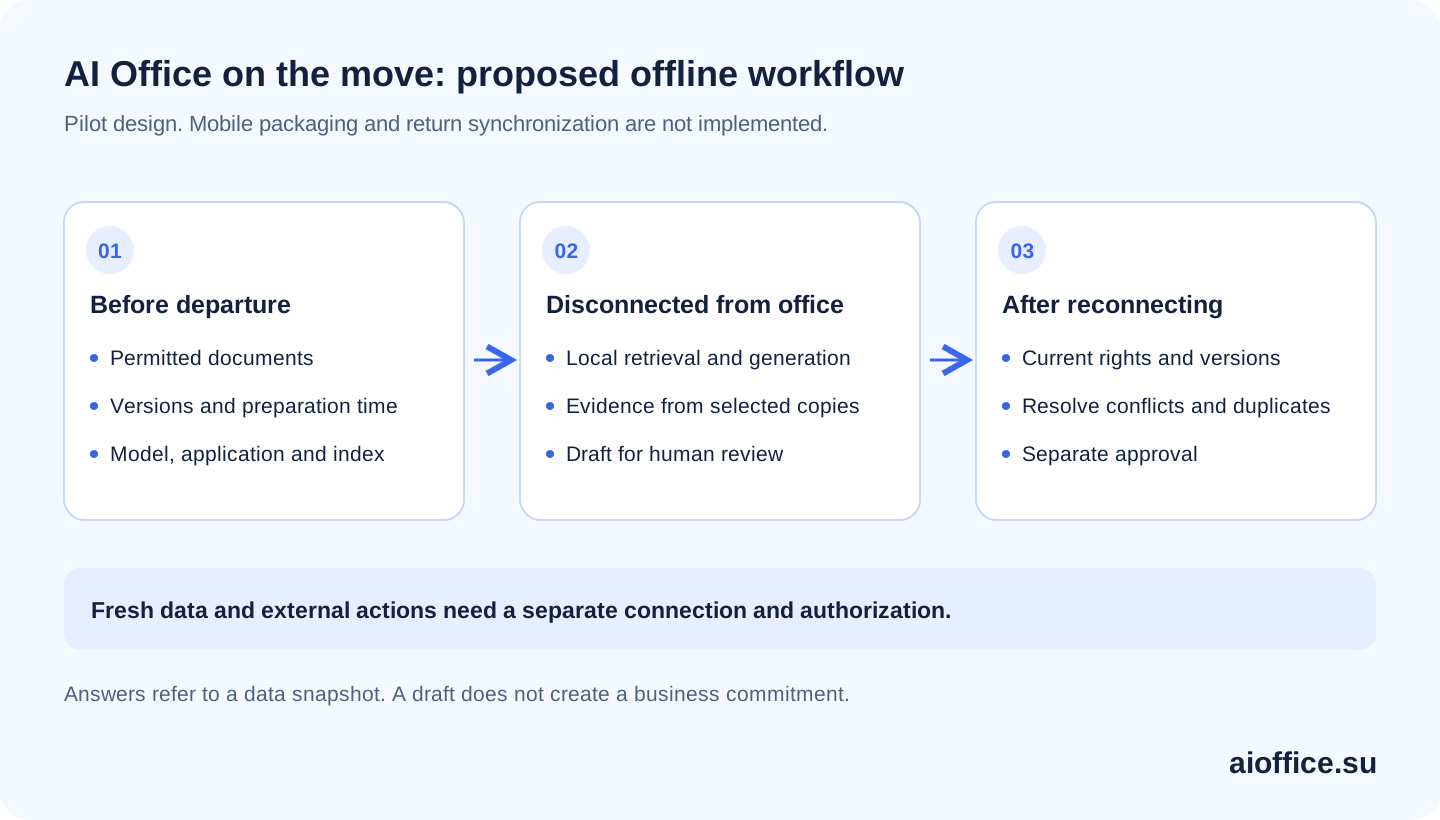
Prepare the model, tokenizer, index, applications and dependencies beforehand. First use should not unexpectedly require internet access on the aircraft. Check application sign-in, component licences, local fonts, export and starting after a reboot as well.
Returning to the office requires more than uploading everything. Current permissions, source versions and conflicts need explicit review. A supplier may have changed its offer, or another executive may already have decided. Automatically applying an old draft could create duplicate or inconsistent actions.
Package export, mobile history and return approval are a proposed design, not an implemented AI Office mode. A first pilot can be limited to reading permitted copies and preparing a memo, without writing back to production systems.
Why this platform needs compatibility testing
N1X belongs to the Windows on Arm ecosystem. NVIDIA publishes application-porting resources and development setup guidance. CUDA support does not mean every ordinary Windows or Linux build will work unchanged. NVIDIA: Port Windows applications to RTX Spark ↗
NVIDIA’s October 15 guidance explicitly says Linux Arm64 packages, including DGX Spark builds, cannot run in native Windows Python. Some dependencies may lack compatible prebuilt packages. RTX Spark N1X and desktop DGX Spark should therefore not be treated as identical software environments. NVIDIA: RTX Spark development setup and Windows Arm64 dependency gaps, October 15, 2026 ↗
AI Office has demo, Ollama and compatible HTTP provider modes. These support designing a connection to a local model server, but do not establish whole-application N1X compatibility. Environment, GPU acceleration, retrieval, document export and recovery require validation.
The prototype also has no automatic email, CRM or accounting connector. OCR for scanned documents is unavailable. A model’s vision component does not itself add scan processing to the product.
Offline control also creates a local copy
If generation and retrieval are genuinely local, a document need not go to an external model for each question. Files could still leave through folder synchronization, telemetry or an agent tool. Check actual data routes and provider-unavailability behavior before a pilot.
The executive’s laptop becomes another location for sensitive information. Limit package contents, govern sign-in, protect the disk and keep recovery material separately. Microsoft describes BitLocker as volume encryption that mitigates unauthorized access to data on lost devices. It does not constrain an already active session or an authorized user’s actions. Microsoft: BitLocker volume-encryption overview ↗
Revoking server permissions cannot immediately erase a copy on a disconnected laptop. Local-access lifetime, policy updates and lost-device handling must accommodate that limitation. Immediate remote deletion without connectivity cannot be promised.
Choosing a configuration and testing its value
Select memory for the validated task and complete working set. A 64 or 128 GB configuration may provide different headroom for models, context and ordinary applications. More memory does not establish suitable speed or make the laptop a shared server for every employee.
Travel requires battery evidence for local generation itself. Video-playback endurance cannot be transferred to sustained AI analysis; Microsoft documents those battery-test conditions separately. We have not measured N1X battery drain, heat or tokens per second. Microsoft: Surface Laptop Ultra, unified-memory and battery-test limitations ↗
A practical pilot covers one trip and one process. Before purchase or deployment, assemble reference documents, expected questions and insufficient-information cases. Assess results, citations, corrections, latency, memory and battery under ordinary office workload too.
Then disconnect the external network and repeat startup, search, document preparation and persistence after reboot. On reconnecting, test changed data and conflicts. Acceptance should cover the complete workflow that matters.
RTX Spark N1X offers an opportunity to carry local computation alongside work context. We can examine an executive’s AI Office scenario, choose a model and data scope, then validate a bounded mobile pilot. Its purpose is useful decision preparation where connectivity is unavailable or external processing is not permitted.