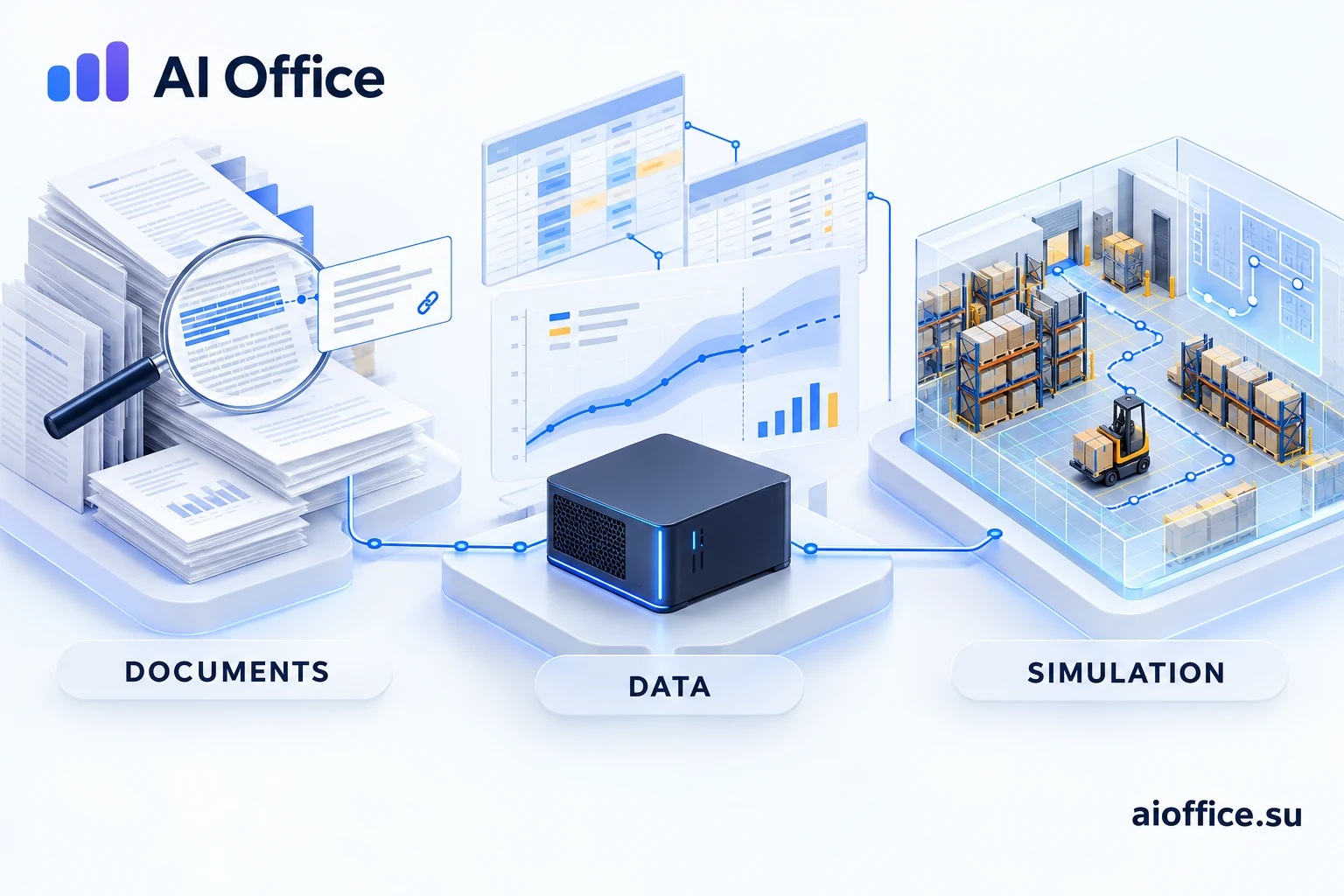
A company needs more than a chat interface that answers confidently. It needs to locate the right contract clause, explain stock changes, prepare a request or investigate a rare industrial situation. NVIDIA's autumn announcements are interesting because they separate these jobs: Nemotron handles dialogue and tool use, Retriever helps find evidence, Kumo predicts from structured data, and Cosmos addresses physical scenes. This guide explores how those components could support a useful business workflow and what belongs in a local AI station pilot.
What is available, and which dates have changed?
NVIDIA's 21 October 2026 overview brings together families with different release histories. Sources for this article were checked on 24 October. Nemotron 3.5 Super VL and Bolt 74B were introduced on 15 October. The smaller Bolt E4B was scheduled for 23 October and has now received its own release announcement. Describing E4B only as promised before month-end would therefore be outdated. NVIDIA: open-model portfolio, 21 October 2026 ↗ NVIDIA: Super VL and Bolt announcement, 15 October 2026 ↗ NVIDIA: Bolt E4B release, 23 October 2026 ↗
The overview schedules Alpamayo 2 Edge for later in October. We treat that as the published announcement rather than a verified deployment package. Model files, a usable library and a compatible serving recipe are also different milestones: downloading weights is not the same as implementing a business process.
| Family | Role | Availability and boundaries |
|---|---|---|
| Nemotron 3.5 Super VL | Dialogue, visual context, tool calls | Published; serving recipe needs hardware-specific validation |
| Nemotron 3.5 Bolt 74B | Local agentic tasks | Published, including a 24GB package |
| Bolt E4B 4GB | Compact conversational assistance | Release confirmed on 23 October 2026 |
| Nemotron Retriever | Parsing, retrieval and reranking | Separate model weights available |
| Kumo and Kumo Engine | Prediction, connected tables, data preparation | Models and library available; their responsibilities differ |
| Cosmos 3 | Scene understanding, generation and simulation tasks | Documentation provides Edge, Nano and Super |
| Alpamayo 2 Edge | Specialised autonomous driving | 21 October announcement: release later in October |
Nemotron: dialogue, visual understanding and tool calls
Super VL targets multimodal agentic work involving text, images and sequences of tool calls. Bolt targets a smaller deployment footprint. For example, the published Bolt 74B-A9B 24GB package uses its own compressed format. That describes a particular package and supported workload, not identical memory consumption on every computer. NVIDIA: NVIDIA-Nemotron-3.5-Super-VL-120B-A12B-NVFP4 · model-card snapshot ↗ NVIDIA: NVIDIA-Nemotron-3.5-Bolt-74B-A9B-24GB · model-card snapshot ↗
Consider a service assistant. An employee attaches an equipment-label photograph and asks which documents are required for a request. The model helps interpret the image; the application then queries an authorised catalogue and prepares a draft record. If the equipment variant is unclear, the assistant asks. Image understanding does not remove the need to verify manual applicability.
Bolt E4B is a candidate for short conversations and multi-turn tool use. A voice workflow still requires speech recognition and synthesis: one language model is not the complete voice pipeline. A pilot evaluates request interpretation, correct parameters and time to an accepted result across all components.
The useful outcome is an employee reaching a verified result. Well-written prose is only one stage.
Retriever: why retrieval quality can matter more than model size
Nemotron Retriever contains specialised components. Parse converts document-page images into structured text with layout information and reading order. This can help preserve the relationship between headings, tables and illustrations. Recognition failures still need evaluation on actual document formats. NVIDIA: Nemotron-3.5-Parse · model-card snapshot ↗
An embedding model represents queries and material in a form suitable for similarity search. A reranker evaluates which retrieved candidates best answer the question. Published Nemotron 3.5 Embed and Rerank models support text and visual documents. They select evidence; a generator expresses the explanation. NVIDIA: Nemotron-3.5-Embed-1B-BF16 · model-card snapshot ↗ NVIDIA: Nemotron-3.5-Rerank-8B-BF16 · model-card snapshot ↗
Imagine a buyer asking which delivery deadline was agreed for an item. A folder contains a contract, specification and several offers with different dates. Parsing extracts structure, retrieval finds candidates and reranking prioritises relevant passages. Document currency, however, requires separate version metadata: an obsolete file does not become authoritative merely because it matches well.
A useful output gives the deadline, source page, document version and any conflict. Permissions are checked before passages reach the model. This pattern applies to contracts, manuals, technical catalogues and internal procedures.
Kumo: predictions from tables rather than plausible spreadsheet summaries
Kumo includes models for individual tables, connected tables, time series and anomaly detection. These are predictive tasks such as classification, numeric prediction and unusual-pattern detection. A language assistant can explain outputs and clarify requirements, but it should not replace a predictive calculation with an invented number. NVIDIA: Kumo models and libraries ↗
Preserve relationships such as customer–orders–items–deliveries. Flattening everything into one long text string discards some of that structure. First define identifiers, timestamps, the target outcome and information genuinely available at decision time. Then assess whether the history is sufficient for the task.
Suppose a distributor wants to identify products likely to run short next period. It needs demand history, availability, supplier lead times and an agreed horizon. Forecast is a candidate for the numerical series; its model card describes combining forecasting with retrieval of historical patterns. Turning demand predictions into purchasing requests requires separate rules accounting for existing orders and business constraints. NVIDIA: Kumo-Forecast · model-card snapshot ↗
Equipment monitoring offers another possibility: unusual sensor dynamics. Send an alert to a specialist with the affected interval and original values. An anomaly score is not a diagnosis. Establish how many unnecessary alerts the team can handle.
Why Kumo Engine is a separate component
Different libraries surround Kumo. Pretrained Tabular and Relational run through Structured Data Models; Forecast and Anomaly use Kumo-TS. Kumo Engine has a separate responsibility: preparing connected-record context and supporting training and batch prediction. Its README describes SSD indexing and time-correct data sampling; the repository carries Apache 2.0. NVIDIA Kumo Engine · source snapshot ↗
For a business, the value is controlled use of history and relationships when a flat report is insufficient. It is not a button for uploading accounting data and answering every question. A project needs a schema, a predictive objective, evaluation and suitable infrastructure. A complete training pipeline may be unnecessary for a small first pilot.
Four business workflow examples
In the first scenario, a manager prepares a document-based customer reply. Retriever selects evidence, Nemotron drafts the response and the employee checks sources and terms. In the second, a planner compares demand forecasts with a simple baseline before considering stock options. In the third, a service team investigates unusual time series. The fourth concerns industrial development using synthetic scenes.
| Workflow | Required inputs | Output | Evaluation |
|---|---|---|---|
| Contract or manual reply | PDFs, page images, versions and permissions | Supporting evidence and a response draft | Source correctness and review time |
| Inventory planning | Demand history, availability and deliveries | Forecast and a planner’s decision draft | Forecast error against a baseline |
| Equipment monitoring | Measurement time series | Unusual interval for a specialist | Missed events and unnecessary alerts |
| Industrial visual system | Real scenes and defined conditions | Synthetic examples for evaluation | Final-system quality on real data |
These are proposed workflows, not claims about our completed deployments. Databricks' own 21 October publication describes Kumo for structured predictions and Retriever for evidence retrieval within its workflows. This illustrates an integration direction reported by that company; it does not establish savings or quality for another company's data. Databricks: NVIDIA model integration announcement ↗
Cosmos: understanding and modelling physical scenes
Cosmos 3 documentation lists three main sizes: Edge at 4B, Nano at 16B and Super at 64B parameters. The family distinguishes scene-understanding and generation surfaces; outputs depend on the chosen mode and integration. Those distinctions are more useful than treating it as one model for everything physical. NVIDIA: Cosmos 3 model reference and sizes ↗
A warehouse or manufacturing team could explore generating rare situations to train or evaluate a visual system. Examples include partial occlusion and unusual lighting. October's Cosmos Data Factory update addresses data curation, annotation, generation and evaluation for physical scenarios. A particular facility still needs its own material and acceptance criteria. NVIDIA: Cosmos training, evaluation and data workflows ↗
Generated video does not itself establish route feasibility or actual warehouse throughput. Those require an engineering model, environmental constraints and real measurements. A sensible pilot evaluates the final system on an independent set of real scenes before and after synthetic examples are added.
Alpamayo 2 Edge is a specialised automotive direction. Its announcement identifies DRIVE AGX Thor optimisation and scene-understanding and motion-planning tasks. It belongs to a separate engineering project with its own testing, rather than being a ready-made autopilot for an office AI station. Most businesses can start much closer to their daily operations with documents and tables.
Building a workflow from the components
The proposed architecture selects components by input type. Documents go through parsing and retrieval, tables through predictive processing, and physical scenes through a separate research pipeline. A shared workspace can expose evidence, job states and next steps. A single workflow does not require loading every family.
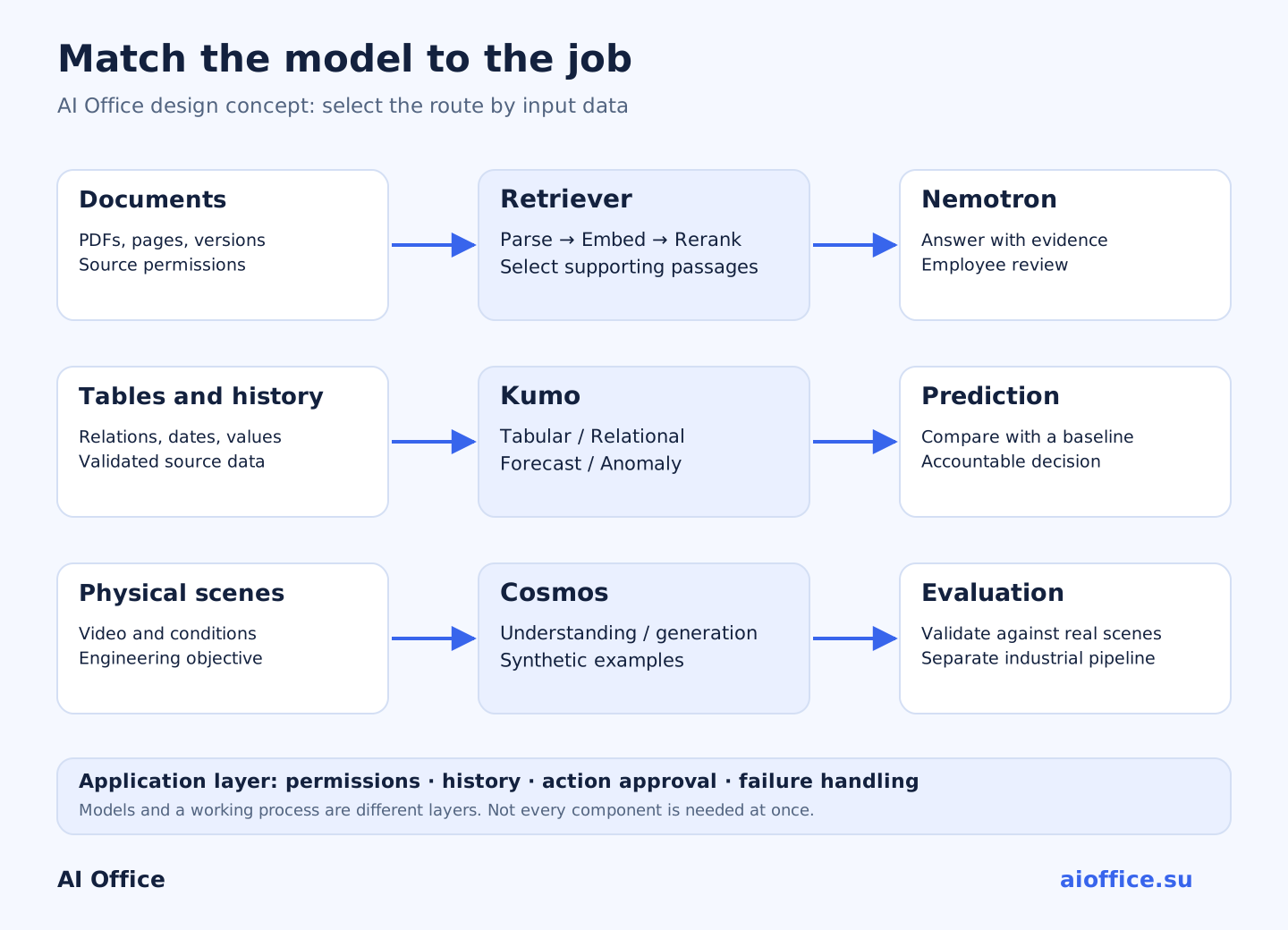
Writing to 1C, sending a message or changing a supply plan uses approved application tools. A persuasive forecast does not authorise a purchase. Actions require current data, an accountable person and recorded outcomes, including connection-failure handling.
What local deployment actually requires
Open weights make customer-controlled hosting an option. Compatibility remains a separate question. Many NVIDIA recipes rely on its GPUs and software stack; Engine documentation also specifies environment, SSD and GPU-training requirements. A station on another platform should not be assumed to support every package automatically.
Even with 128 GB installed, test weight format, context length, visual inputs, request queues and application headroom. For mixture-of-experts models, active parameter count is not the full model size. Packages labelled 24GB or 4GB do not describe the whole working system's memory. Select a compatible set for the task instead of fitting the entire model catalogue at once.
Check each component's terms. Engine and some forecasting packages identify Apache 2.0, while other packages use OpenMDW 1.1. These are distinct documents, not a single licence covering the collection. End-to-end locality also requires checking where OCR, search, telemetry and integrations send information.
Choose a pilot with a measurable outcome
For retrieval, prepare questions with known answers, current sources and cases where evidence is missing. Evaluate finding the right passage separately from explaining it correctly. For prediction, split history by time so that future events cannot leak into training or context. Compare against an understandable baseline, not just an attractive chart.
Include human review time and substantial corrections, then decide which roles and tools to expand. AI Office can help examine a company's process, select compatible components and develop a tailored connection to its documents and business systems. Start with one repeated assignment whose quality and usefulness can be tested.