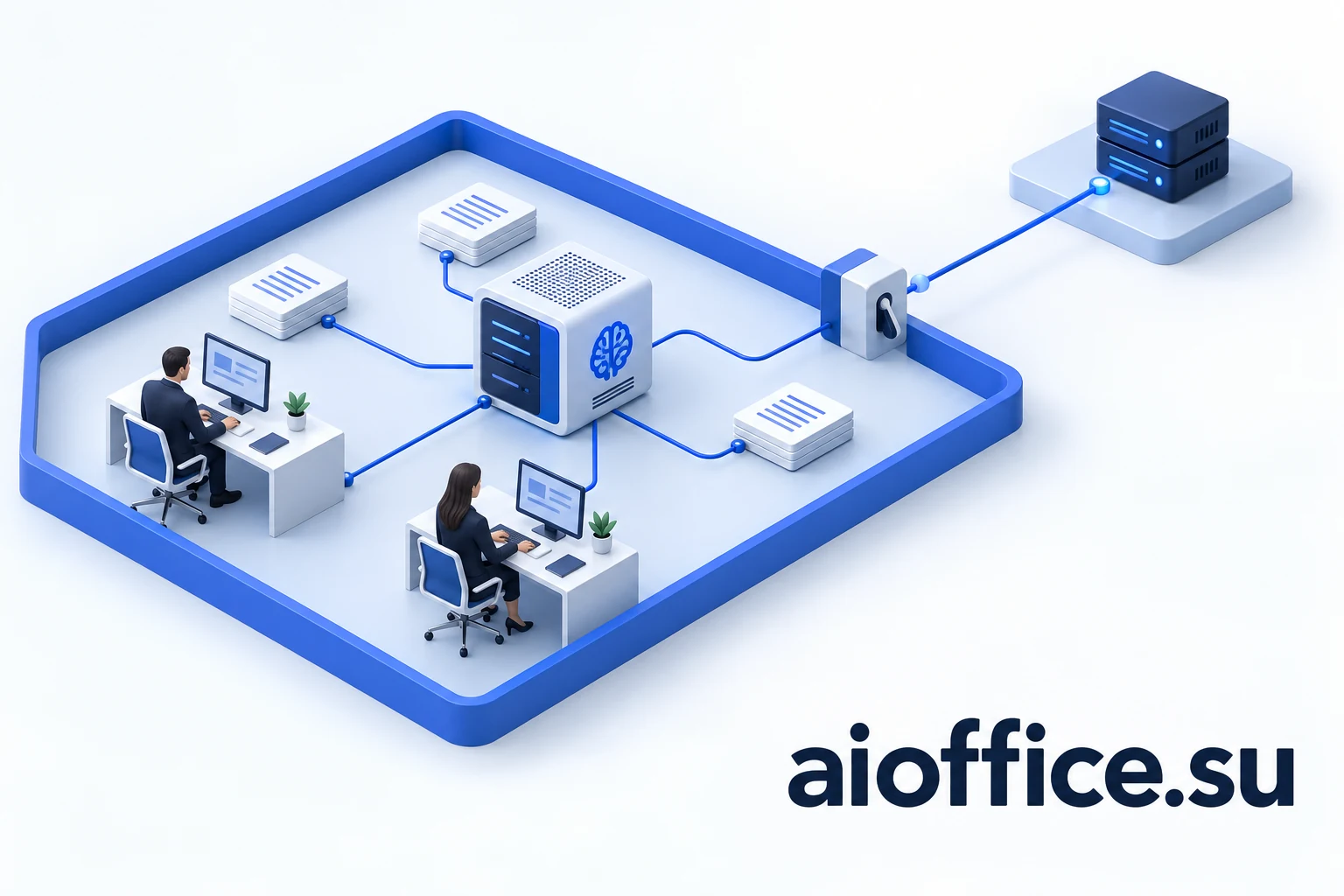
“Our AI runs in a closed environment” sounds like a complete security answer. Yet it can describe an office model, a dedicated data-center server, a cloud-connected hybrid or a system with no external network connection.
A company needs to know where every type of data is processed, who has access and which external connections are necessary. Define a closed AI environment through boundaries and operating rules rather than the location of one device.
What a closed environment means here
In this article, it means a defined environment with specified sources, users, components and controlled exchange beyond its boundary. Isolation depends on project requirements. The label alone does not establish whether internet access is completely disabled.
Local AI performs computation on selected company equipment. On-premise generally describes deployment within company infrastructure. Private AI can describe different dedicated or controlled-access arrangements. These terms help start a conversation but do not verify a solution.
An environment without direct external network connectivity is a stricter arrangement. Installation, updates, document transfer and maintenance need separate procedures. Isolation still leaves risks from users, media, software components and configuration mistakes.
Three different arrangements
The first is a local model with permitted external access. Answers are mainly generated on company equipment, while web search, email or processing steps may use external services. This does not promise that data never leaves the company.
The second is local-first with controlled exceptions. Routine work stays inside; external models handle approved data categories and tasks. The route should be visible and governed by rules, not silently enabled whenever a difficult question appears.
The third is an autonomous environment for a specified feature set. Necessary models, documents and tools are internal, with external dependencies removed from the working path. Its value depends on exactly what still works offline.
Trace the complete document path
Imagine a contract uploaded into a local chat. The language model runs in the office, but scans go to an external OCR service. Alternatively, the text stays local while a cloud API calculates search embeddings. LLM location does not describe the entire data route.
Map upload, recognition, extraction, retrieval, answer generation, logs, usage analytics and backups. Record which component receives the original, excerpts, vector representations or technical metadata.
Do not assume derived data is harmless. Search indexes, logged excerpts and saved answers can contain sensitive information. They need access, retention and deletion rules linked to the source documents.
Your own AI need not be trained from scratch
Companies can often deploy an existing model on selected hardware under its license. Connecting corporate documents through retrieval and RAG does not mean those documents have been written into model weights.
RAG retrieves relevant passages and supplies them as answer context. It can support answers grounded in company material but does not guarantee correctness: retrieval may select an old version and generation may misinterpret it. Retain evidence links and evaluate quality.
Fine-tuning is a separate tool for particular needs. It does not replace current documents, permissions or data updates. A first project should test retrieval and an existing model on real workflows before promising to train AI on the entire business.
Verify actual settings and network behavior
Even model-running software can combine local and cloud features. Ollama's FAQ separately discusses local operation, cloud capabilities and network settings. Check the selected stack's actual mode and model rather than its product name alone. Ollama · FAQ ↗
A technical pilot should identify permitted connections and observe representative workflows. Check model downloads, updates, external tools, telemetry and diagnostic information sent for support.
Disabling one cloud API is insufficient if another processing step remains external. Conversely, internet access for updates does not prove every user request leaves the company. Specify and verify the actual routes.
Internal networks still require permissions
Employees from different departments, contractors and compromised devices may share a network. Network membership should not automatically unlock every AI document and tool.
NIST SP 800-207 rejects implicit trust based solely on physical or network location. For local AI, company deployment does not replace authentication and resource authorization. NIST · SP 800-207 Zero Trust Architecture ↗
Enforce rights before supplying model context. If an employee cannot access an HR document, do not insert its passages and hope the model stays silent. Also check file delivery, exports, logs and administration.
Isolation does not prevent every agent error
An authorized document or email can contain a hostile instruction. Prompt injection attempts to turn material the system should analyze as data into behavioral instructions. OWASP discusses this risk and layered defenses, including separating instructions from data and restricting tools. OWASP · Prompt Injection Prevention ↗
Consequences depend on authority. A read-only assistant might answer incorrectly; an agent that can modify, send or delete records can cause more damage. Expanded action permissions require separate evaluation even when all computation is local.
Approval for consequential actions, restricted access, output checks and logs remain necessary inside the boundary. A capable model and local server do not replace these mechanisms.
Updates and backups belong in the design
A closed environment should not become an unmaintained one. Define how software and model versions are obtained, their origin checked, changes tested and working versions restored after problems.
Backups have locations, owners and permissions too. Keeping live data locally while sending copies to an unexamined external service makes the storage claim incomplete. Agree backup contents, encryption, key custody and recovery tests.
Recovery requires more than files: configuration, models, indexes, permissions, integrations and appropriately stored secrets also matter. An archive alone does not demonstrate that a selected business process can resume quickly.
When local AI makes sense
Local architecture can support control of sensitive document processing, tailored access rules, fewer external dependencies and selected offline functions. These benefits also require infrastructure and operational support.
For small volumes of public text without isolation requirements, a cloud service may be simpler. If the company cannot maintain equipment and security processes, placing a server in the office does not automatically improve its position.
Compare architectures for the same task: quality, latency, cost, model options, operating mode and maintenance responsibility. Choose from company requirements rather than a universal claim that local is always better.
Acceptance criteria for the environment
List functions that must operate locally, permitted external connections and data categories for each. Test normal operation, internet loss, unavailable sources and attempts to retrieve unauthorized documents.
- Every component has a known execution location and data scope.
- External connections have defined purposes and restrictions.
- User permissions apply to retrieval, responses and tools.
- Cloud failure does not trigger an unapproved external fallback.
- Backups and updates respect the stated boundaries.
- Recovery of the selected process has been tested.
These are design and acceptance criteria, not a claim that any local-model product already satisfies them. Name network-dependent functions and show what happens when they fail.
AI Office and the company boundary
AI Office is designed around a local AI station and software platform within company infrastructure. External models and integrations follow an agreed architecture. Features, permissions, hardware compatibility and offline behavior are validated in the pilot.
Start with two lists: data that must remain inside and tasks that must run without external services. They support a verifiable boundary, model selection and an operating plan. That gives the company more control than a private-AI label alone.