
A story about thousands of AI agents tackling a Millennium Problem is easy to read as a promise that models can now do anything. For an owner, engineer or manager, the useful question is how the work is organised and what counts as its result. A persuasive answer, an inspectable artifact and an accepted discovery are different stages.
OpenAI's Navier–Stokes experiment provides an opportunity to examine those stages. The scientific claim needs careful attribution, while the organisational questions are immediately familiar: who defines the task, which tools are available, how many attempts are allowed and how the output is checked.
What was announced and where the result stands
OpenAI's 8 September 2026 account reports roughly 10,000 agents using an internal model, 88 hours of search, another 17 hours for Lean formalization and verification, and about 130 billion output tokens. Researchers directed groups and reallocated resources. OpenAI · On the Navier–Stokes Millennium Prize Problem ↗
When checked on 9 September 2026, the Clay Mathematics Institute website still listed the problem as unsolved. We therefore describe a proposed proof and published materials, rather than a conclusively accepted Millennium Problem solution. The institute's current listing is not itself a refutation of the work either. Clay Mathematics Institute · Navier-Stokes Equation: current status ↗
Clay's prize rules require publication in a qualifying outlet, at least two years afterwards and general acceptance by the mathematical community. That process is separate from an announcement or the existence of a proof file. Clay Mathematics Institute · Rules for the Millennium Prize Problems ↗
What the Navier–Stokes question means
The equations model fluid motion. The official problem concerns three-dimensional incompressible flow: whether smooth solutions persist under specified conditions, or whether a breakdown example can be constructed. Its alternatives impose requirements on initial data, forcing and energy. Charles L. Fefferman · Official Navier–Stokes problem description ↗
The paper claims that smooth external forcing can produce unbounded velocity in finite time while kinetic energy remains bounded. The authors connect their construction to alternatives C and D of Clay's problem. This is a specific claim about mathematical solutions. OpenAI · Finite time blowup for Navier–Stokes: proposed proof ↗
It does not supply a universal calculation for every ventilation system, pipeline or aircraft. An engineering tool still needs a model of the object, boundary conditions, numerical methods, inputs and applicability checks. Each has its own quality criteria.
What formal verification in Lean provides
A public repository accompanies the paper with Lean formalizations and checking instructions. Readers can inspect a machine-checkable representation alongside the written argument. Our editorial team has not built this formalization or conducted a mathematical review. OpenAI · NavierStokesAndEuler formalizations ↗
Lean supports formalizing and checking proofs. Its small checking kernel checks formal proof terms. Translating the original question also matters: verification applies to the recorded statement and its assumptions. It does not automatically establish that the formalization covers everything a reader inferred from the headline. Lean · The Lean Language Reference ↗
For a non-specialist, three questions help: what do the authors claim, can the supporting argument be checked, and have specialists accepted the result in that sense? Answering one should not silently answer the others.
The more complex the task assigned to AI, the more important it is to define how its result will be checked.
Why several agents might work on one task
In an applied system, an agent can be understood as a model-driven process with a task, permitted tools and intermediate state. Multiple agents can divide work: collecting sources, checking constraints or preparing a candidate result. This is a possible application design, not a description of the internal roles in OpenAI's experiment.
Parallel work helps when parts can genuinely be investigated independently. Results still need consolidation: participants may use different document versions, interpret terms differently or repeat the same mistake. Define the handover format and how contradictions are resolved.
More participants do not establish higher quality. If everyone received an incomplete source document, agreement among models will not recover its missing page. A reviewer who sees only the first agent's polished summary may endorse an error without opening the evidence.
Design distinct responsibilities and permissions rather than simply increasing query volume. Specify each participant's assignment, where its result is stored and who decides that work is complete.
From an assignment to an accepted result
A useful corporate workflow defines requirements, performs bounded retrieval or preparation, consolidates evidence, runs separate checks and sends the result to an accountable person. The following is a proposed application workflow, not a reconstruction of OpenAI's research system.
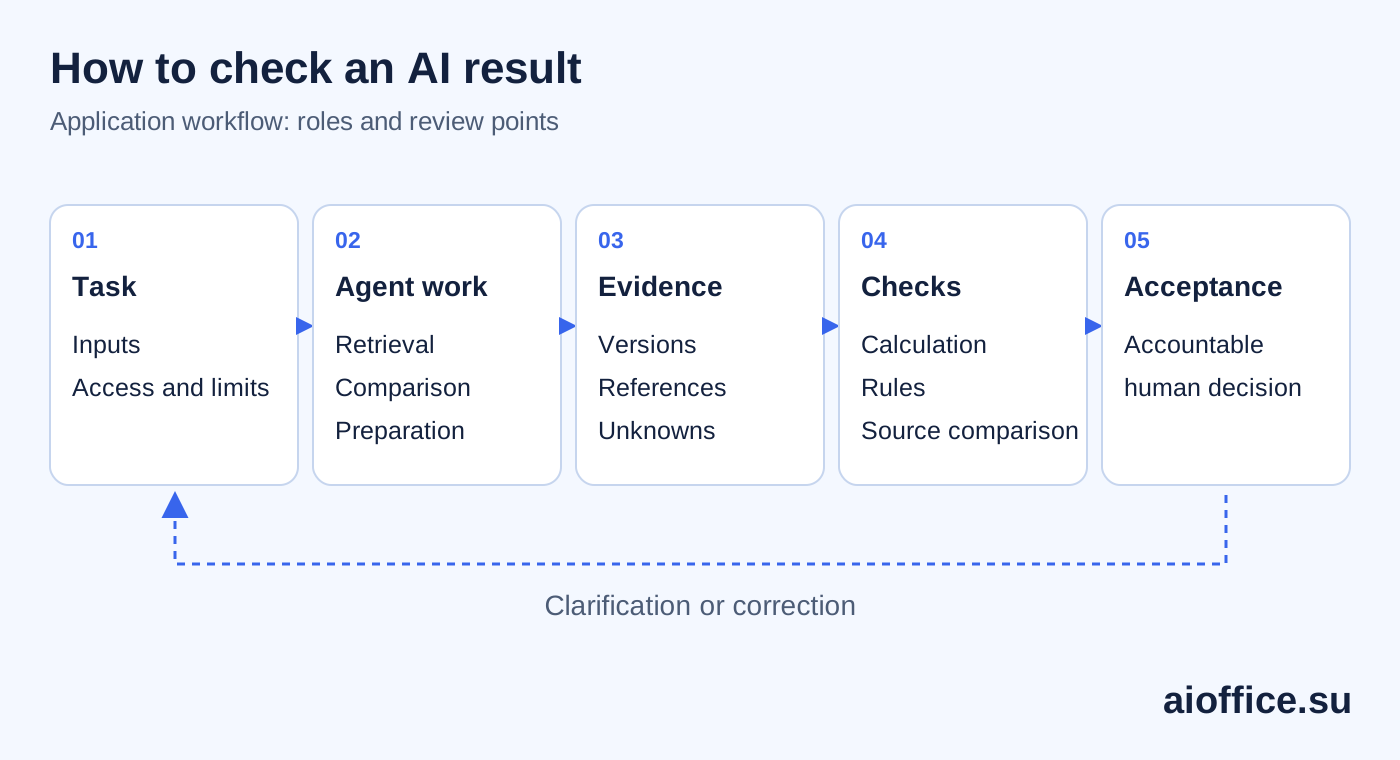
Record the input documents and versions at the start. Define a concrete output at the end: a draft proposal, compliance matrix, calculation or unresolved-question list. “Figure it out and do a good job” does not specify authority or completion criteria.
At every handover, carry sources, assumptions and limitations alongside the conclusion. A missing document should remain visible through successive summaries and in the final artifact.
Example: a proposal for engineering equipment
Consider preparing a commercial proposal from a property specification listing items, quantities and technical requirements. Available inputs include a catalogue, manufacturer documents and delivery terms. This is an illustrative proposed workflow, not a completed customer order.
First extract requirements and link them to the original specification. Then find candidates in the permitted catalogue. Compare their characteristics and flag mismatches: a different power supply, incomplete configuration, unknown interface or missing supporting document.
Calculate prices using approved data and rules. A model should not invent a price, rounding convention or tax treatment from a similar example. Where alternatives cover different delivery scopes, ranking only their totals is misleading.
The result is a draft proposal with evidence: each item's origin, the source of each stated characteristic and conditions still needing clarification. A manager reviews disputed points, while an appropriate specialist confirms technical choices. Sending the proposal to the customer remains a separate action under agreed authority.
| Check | Method | Human responsibility |
|---|---|---|
| Items and quantities | Compare specification and catalogue version | Resolve ambiguous matches |
| Technical characteristics | Reference documents for the specific model | Assess applicability and approve substitutions |
| Price | Calculate from approved inputs and rules | Confirm prices and commercial terms |
| Proposal completeness | List required information and unknown conditions | Decide whether it is ready to send |
One agent with several tools may be sufficient. Multiple agents are justified where division of work produces measurable benefits. Choose their number after testing the workflow on representative cases.
Checking a document differs from proving a theorem
A flawless calculation may use an outdated price. An accurate contract summary may omit an appendix absent from the upload. Two products are not necessarily compatible because their descriptions share a term.
Checks therefore take different forms. Software can recalculate arithmetic or validate required fields. A characteristic can be compared with its source. Completeness and the suitability of a technical choice may require specialist assessment.
Show exactly what was checked. “AI verified” is too vague. A more useful status says that totals were recalculated, items were linked to a catalogue version, two characteristics lack evidence and an equipment substitution awaits approval.
This preserves accountability and directs attention to material questions. It does not turn a business document into a mathematically proven truth, but makes review more understandable and reproducible.
Budget the complete workflow
A large generation volume indicates the scale of work without disclosing its production cost. Public prices for a different product cannot be applied to an internal research model without further information. Nor can a potential prize be assumed to cover the experiment.
For an applied project, count the whole route: document reading, repeated requests, checks, waiting and human corrections. Include source maintenance. A fast response can still be inconvenient when every suggestion needs lengthy review.
Set limits on time, attempts and permitted spending before execution. Define stopping conditions too: missing evidence, contradictory candidates, an exhausted budget or a required human decision. Endless search should not conceal the absence of a usable result.
A useful measure is cost per accepted task including review. Compare it with the existing process on comparable cases. A research record does not establish that measure for another organisation.
Scientific priority and data provenance
The story also has a disputed dimension. Tristan Buckmaster described concerns about his interactions with OpenAI and the presentation of contributors' work. His statement explicitly says he does not know whether their data was used. This is a participant's account, not an established finding of appropriation. Tristan Buckmaster · Public statement on concurrent work ↗
OpenAI denies accessing specific user data to solve the problem, while not ruling out an indirect contribution from de-identified usage data to model improvements. It also points to differences between the works. OpenAI · On the Navier–Stokes Millennium Prize Problem ↗
Distinguish mathematical scrutiny from the dispute over the work's origins. A successful proof would not settle authorship questions by itself; a dispute would not refute the mathematics by itself either.
For projects with confidential information, define permitted sources and retain material provenance. This dispute does not establish that every cloud service uses customer secrets. Check the data-processing policies and terms of the particular service separately.
What applies to AI Office today
The AI Office software prototype implements some foundations of this approach: document retrieval with permission checks, source versions, links between proposals and catalogue rows, and decimal monetary calculations. Prepared documents can be exported, and designated actions require approval. These capabilities belong to specific implemented workflows.
Automatic engineering assessment and a universal research-agent team are not claimed as ready-made features. The example above requires additional matching rules, technical sources and testing. The current prototype also does not send supplier proposals or provide live email, CRM and accounting connectors.
A local AI station addresses where permitted work runs and where corporate context resides. Local deployment does not confer the capabilities of an unreleased research model. Using external models, if needed, requires a separate decision about data, quality and cost.
Start with one recurring task: define a good result, assemble evaluation cases and describe the grounds for acceptance in advance. That gives an AI Office project a concrete foundation without promising to reproduce a frontier research experiment inside an ordinary office.