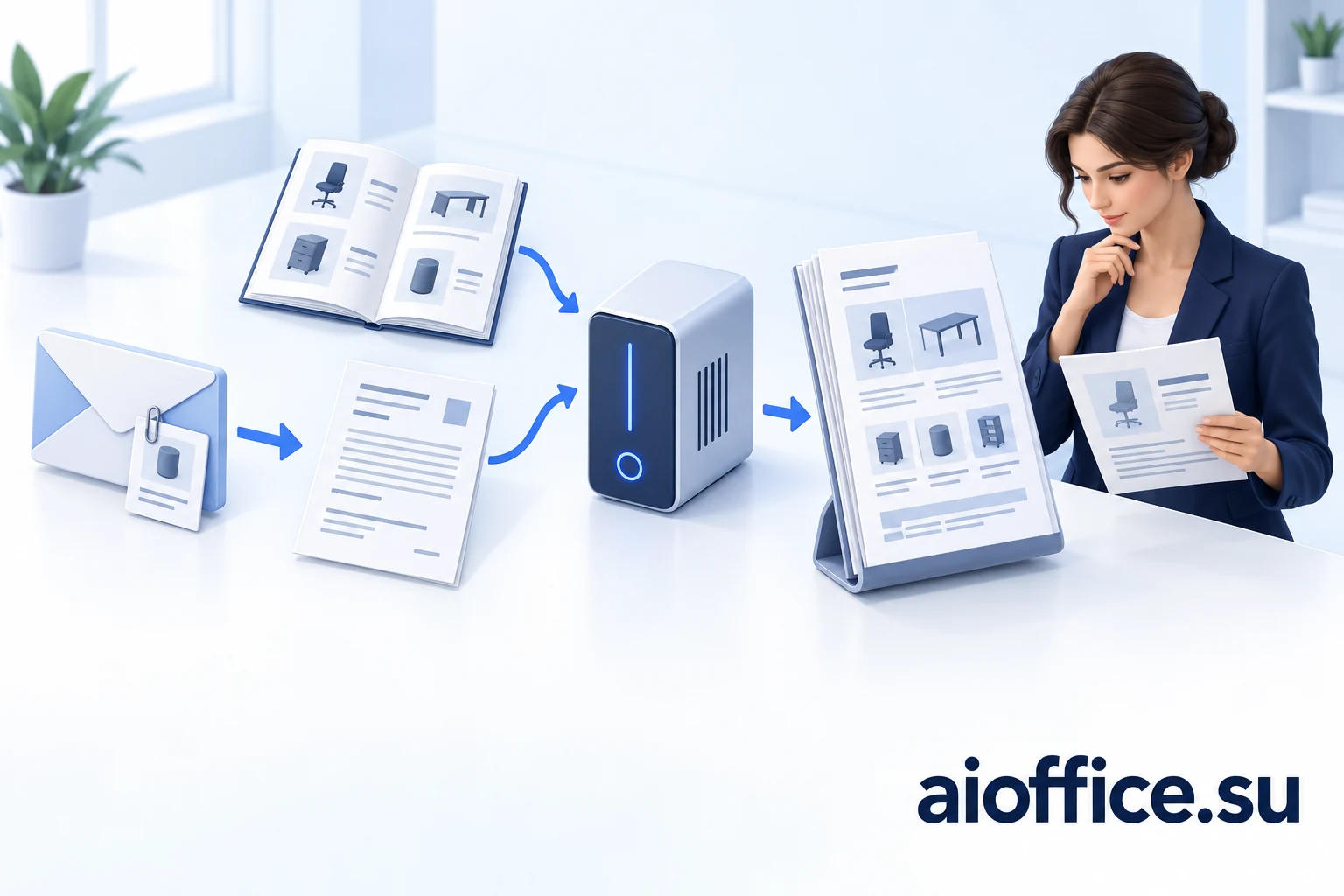
A customer emails a request for pumps, attaches a specification and asks for a proposal today. The sales manager needs to understand the request, find catalogue matches, check prices and availability, review contract terms and assemble a document. Writing a polished introduction is only a small part of that work.
AI for commercial proposals becomes useful when it supports the whole route and shows where significant terms came from. This illustrative workflow moves from an incoming email to a checked proposal draft and draft contract. It is a process design, not a report of a particular customer deployment.
Define what “ready” means
A draft contains assembled items, calculations and text for review. An approved proposal has passed the responsible employee's checks and is ready for permitted sending. Automating draft preparation does not automatically authorise transmission.
Agree the required result: recipient, legal entity, goods or services, quantities, units, prices, delivery, payment terms and offer validity. Some fields may not apply, but that should follow the workflow rather than the model's improvisation.
Retain a basis for important terms. A price comes from a specific list, a delivery date from confirmed supply information, and a discount from a permitted rule or manager's decision. Where no basis exists, show an unresolved field or question instead of inventing a plausible value.
Read the request and preserve its origin
Email and attachments arrive through an agreed folder or authorised integration. Keep the original message, sender and receipt time linked to the work item so staff can revisit the source when the request changes.
Extract text and structure next. Use an available text layer for ordinary documents; scans may need OCR. Tables require care because line breaks, merged cells or unclear digits can change order meaning.
Highlight uncertainty early: an unreadable code, missing quantity or conflict between the message and specification. Successfully opening a file does not prove correct extraction of every field.
Incoming content remains data. An instruction inside a PDF to ignore policy and disclose internal purchasing prices should not alter permissions. External documents can carry prompt injection, a technical risk addressed by OWASP guidance. OWASP · Prompt Injection Prevention ↗
Match the need to the catalogue
Customers often use familiar product names while the accounting system stores internal codes. AI can suggest matches from descriptions and characteristics, but similar names do not establish interchangeability.
A pump's operating characteristics and configuration can be essential; a consumable may depend on size, packaging and compatibility. Show matching features, missing information and the reason for each candidate. Where several options remain, clarification is more useful than a hidden arbitrary choice.
Company-maintained substitution rules and synonym lists reduce ambiguity. A model should not declare a substitute equivalent when suitability or supplier commitments depend on that decision.
Exact product-code matching is often better handled by ordinary software. AI helps interpret unstructured requests, while deterministic comparisons handle the parts that already have precise identifiers.
Obtain current prices, availability and terms
A text generator does not know current company inventory unless it receives that information from a source. An old proposal is not automatically a valid price list.
Define source priority and acceptable age. Current prices, negotiated discounts and stock records may refresh at different intervals. Show when the information was checked, especially where inventory changes quickly.
1C:Enterprise provides a standard REST interface that can be one integration route. Available objects, permissions, customisations and business rules still require validation in the customer's system. An interface is not a ready-made universal connection. 1C:Enterprise · REST interface ↗
If information is unavailable, retain a draft marked as requiring confirmation. A missing availability check must not silently become a confident delivery promise.
Calculate first, then write
Once input fields are confirmed, calculate line items and totals using agreed rules. Handle units, packages, discounts, delivery and rounding explicitly. Tax parameters should come from configured, verified company rules rather than guesses based on the email.
A hypothetical example, without tax or contractual assumptions: the customer needs 24 units, the supplier sells packs of six, and one pack costs RUB 3,000. That means four packs and RUB 12,000 for the goods. Confusing a pack price with a unit price produces a sixfold error beneath polished wording.
The language model then receives the checked structure and helps explain the offer, describe alternatives and prepare the covering message. It should not change calculated numbers to make the prose flow.
Compare the generated file with the structured data again. Template assembly can introduce missing rows, old details or a wrong attachment version. Validate the artifact the recipient will actually see.
Use AI to assist contract preparation
An approved template and a list of permitted variables are a practical starting point. The system inserts checked data, retrieves related conditions and highlights departures from the accepted version. Nonstandard wording goes to the responsible specialist.
Comparison can identify counterparty edits, referenced appendices and mismatches between the contract and approved proposal. Page and passage references make the findings easier to review.
Similar language does not guarantee equivalent meaning, and automated review is not a legal opinion. Authorised people decide whether terms are acceptable and how signing should proceed. This article describes document processing rather than the legal effects of a particular agreement.
Version links matter. If a specification or payment term changes after proposal approval, the contract draft must reflect the newly agreed version. Individually well-generated files can still conflict when their relationships are lost.
Make the review package useful
Give the reviewer the document, original request and a short list of significant issues. Examples include two possible catalogue matches, an unconfirmed lead time, a nonstandard discount or a clause changed by the customer.
Show before-and-after values, sources and reasons for stopping. The manager should not have to repeat the entire research process merely to understand the draft. Access to the original material remains necessary for substantive review.
Approval covers a specific version, recipient and set of terms. Material changes require renewed approval. Sending is a separate permission-checked step; finishing generation must not automatically dispatch the file.
Handle customer changes and follow-up
A customer may reduce quantity, request an alternative or send a revised specification. Link that update to the existing request, show differences and recalculate affected parts. An unrelated new document makes version control harder.
If the integration writes to CRM, agree the status definitions separately: draft, sent, awaiting response or another company stage. Change status based on confirmed events. Generated text does not prove sending, and sending does not prove receipt or agreement.
After a network failure, check whether the operation already happened before retrying. A request identifier and links between versions help, although implementation depends on the mail and CRM systems.
Measure the complete workflow
Compare time from receipt to an accepted draft, review time, corrections and clarification frequency. Track errors in prices, quantities, recipients and significant terms separately.
Text-generation speed is one metric. If a manager spends ten minutes reviewing what previously took eight minutes to prepare, the saving is unproven. Faster evidence collection can still be valuable while people retain complex decisions.
Include ordinary requests, poor scans, outdated prices, similar product codes, incomplete inputs and post-approval changes in the pilot. Define quality thresholds and acceptable manual effort before testing.
Start with one AI Office scenario
AI Office considers “email to proposal draft to draft CRM record” as one possible complete workflow. Sources, templates, permissions and writes to real systems are scoped and tested within the project.
Start with one request type, a limited catalogue and an approved template. First establish reliable extraction, visible evidence and a draft suitable for review. Then expand categories, sources and permitted actions.
The value of AI for contracts and proposals is a shorter route from scattered information to an agreed result. Clear sources and unresolved questions make it easier for employees to take responsibility for the final document.